


a. State five :
(i) challenges that make conservation of resources difficult; [5 marks]
(ii) ways by which the Government of a country ensures conservation of natural resources. [5 marks]
b. What is an endangered species? [3 marks]
c. A child with blood group O was born to a mother of blood group A.
(i) What is the blood group genotype of the child? [1 marks]
(ii) What are the possible blood group genotypes of the father? [3 marks]
d. State three reasons why genetic variation is important to plants. [3 marks]
A homozygous tall, red flower plant was crossed with a homozygous dwarf, white flower plant. The F1 were selfed and 160 F2 plants were obtained.
a.(i) Name the type of genetic cross. [1 marks]
(ii) State one reason for the answer in 4(a)(i). [1 marks]
b.(i) What is evolution? [2 marks]
(ii) With the aid of a genetic diagram, state the phenotypic ratio of F2 generation. [13 marks]
(iii) Calculate the number of tall and white flowers that would be obtained in the F2 generation. [3 marks]
a. (i) Complete the table below with the respiratory surface of each of the listed organisms.
| organism | respiratory surface |
| Tadpole (2days old) | |
| Cockroach | |
| Domestic fowl | |
| Talinum | |
| Earth Worm | |
| Amoeba |
(ii) State five characteristic features of respiratory surfaces in organisms. [5 marks]
b. Make a drawing, 4 cm – 6 cm long of the respiratory organ in Tilapia and label fully. [9 marks]

b. List five parts of the alimentary canal of an earthworm. [5 marks]
c. State six ways by which water could be polluted by agricultural. [6 marks]
d. Describe briefly the life cycle of a housefly. [5 marks]
e. Make a diagram, 6 cm – 8 cm long of the hypogeal germination in a mature maize seedling and label fully. [8 marks]
Diagrams A, B and C are illustrations of different types of teeth in humans. Diagram D is a representation of the arrangement of teeth in the lower jaw of a human.
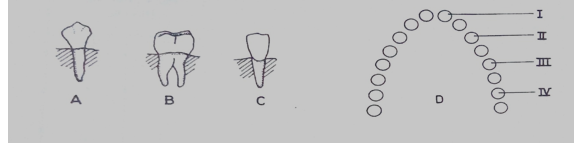
Study them and answer questions (a) to (f).
(a) (i) Name the type of teeth in diagrams A, B, and C.
(ii) Which of the teeth would be found in positions I, II and IV?
(iii)State one function each of the teeth illustrated in diagrams A, B and C.
(iv) State one reason each for the answers in (a) (iii).
(b)If the tooth labeled B is decayed, list two factors that may be responsible.
(c)What is the total number of each of the teeth labeled A, B and C in the dentition of an adult human?
(d)Which of the teeth would be absent in a rabbit?
(e)(i) Name the tooth that would be found in position III of diagram D.
(ii) In which of the parts labeled I, II, III and IV would a tooth not be found in an infant?
(f) State five ways of caring for the teeth in humans.

