


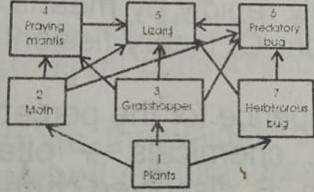
Primary consumers are found in
(a) State two roles each of the following compounds in respiration:
(i) glucose;
(ii) oxygen.
(b) List two types of cellular respiration
(c) Name the structures of gaseous exchange in the following organisms:
| S/N | ORGANISM | STRUCTURE OF GASEOUS EXCHANGE |
| 1 | Ameoba | |
| 2 | Tilapia | |
| 3 | Adult Toad | |
| 4 | Grasshopper |
(d) Make a diagram, 6 cm to 8 cm long of an open stoma in a leaf and label fully.
(a)Describe briefly the process involved in the conversion of food to chyme in the stomach of a mammal.
(b)Complete the table below by stating one enzyme, digestive juice, food acted upon and
end-product in the corresponding spaces.
One Enzyme |
One juice |
One food acted upon |
One end-product |
|
Pepsin (i) ----------- Lipase |
(ii)--------------- (iii)--------------- (iv)--------------- |
(v) -------------------- (vi) ------------------- (vii) ------------------- |
(viii)------------------- Maltose (ix)----------------------- |
(c) Describe an experiment to show that carbon dioxide is necessary for photosynthesis.


(a) Explain briefly the following terms:
(b) List three ecological factors each which are specific to:
(c) State briefly the relationship between green grass and a rabbit in a given habitat.
(d) Draw a typical pyramid of energy using four feeding levels.
(a)(i) State Mendel’s laws of inheritance.
(ii) State five applications of genetics in medicine.
(iii) State three disadvantages of inbreeding.
(b)(i) What is evolution?
(ii) Distinguish between convergent evolution and divergent evolution.
