


(a) State five processes involved in the water cycle.
(b) Name one instrument used for measuring each of the following physical factors:
(c) Explain briefly the contributions of the following scientists to the formulation of the cell theory:
(d) What is meant by each of the following terms:
(e) Make a diagram, 6 cm – 8 cm long of the human tongue illustrating the four areas of taste.
(f)(i) List four ways through which microorganisms enter the human body.
(ii) State three harmful effects of microorganisms to humans.
Diagrams A, B and C are illustrations of different types of teeth in humans. Diagram D is a representation of the arrangement of teeth in the lower jaw of a human.
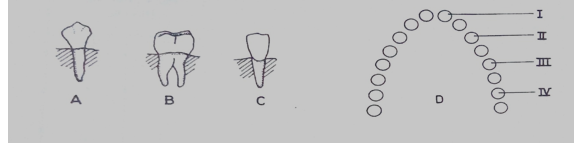
Study them and answer questions (a) to (f).
(a) (i) Name the type of teeth in diagrams A, B, and C.
(ii) Which of the teeth would be found in positions I, II and IV?
(iii)State one function each of the teeth illustrated in diagrams A, B and C.
(iv) State one reason each for the answers in (a) (iii).
(b)If the tooth labeled B is decayed, list two factors that may be responsible.
(c)What is the total number of each of the teeth labeled A, B and C in the dentition of an adult human?
(d)Which of the teeth would be absent in a rabbit?
(e)(i) Name the tooth that would be found in position III of diagram D.
(ii) In which of the parts labeled I, II, III and IV would a tooth not be found in an infant?
(f) State five ways of caring for the teeth in humans.
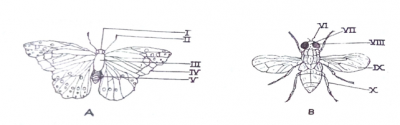
(a)(i) Identify organisms A and B. [2 marks]
(ii) Name the parts labeled I to X. [5 marks]
(b) State one function each of the parts labeled VI, VIII, IX and X. [4 marks]
(c) Name the specific habitats of organisms A and B. [2 marks]
(d) State three structural adaptations of organism A to its mode of life. [6 marks]
(e)(i)State three structural similarities between organisms A and B [3 marks]
(ii) State three structural differences between organisms A and B. [3 marks]
(f)(i) Name the class of organisms A and B. [1 marks]
(ii) State three reasons for the answer in 3 (f) (i). [3 marks]
(g)State one biological importance of organism A. [1 marks]

a. Name five vertebrae in mammals with their corresponding locations. [10 marks]
b. State one function each of the following parts in a dicotyledonous leaf:
(i) palisade;
(ii) vascular bundle;
(iii) epidermis. [3 marks]
c. State one function each of the following parts in the stem of a flowering plant:
(i) sieve tube;
(ii) cortex;
(iii) pith.
d. In a tabular form, state:
(i) two external structural differences between the stem and root of a maize seeding. [2 marks]
(ii) two internal structural differences between the stem and root of a maize seeding. [2 marks]
a. State three features of the small intestine that increase the rate of absorption of digested food. [3 marks]
b. Explain briefly what happens to the glucose formed in a plant during photosynthesis. [3 marks]
c. Explain briefly the mode of feeding in each of the following organisms:
(i) Euglena; [4 marks]
(ii) Spirogyra. [4 marks]
d. State three characteristics of an Estuarine habitat. [3 marks]
e. State three differences between an aquatic habitat and a terrestrial habitat. [3 marks]

