


(a) Given that \(x = 3i - j, y = 2i + kj\) and the cosine of the angle between x and y is \(\frac{\sqrt{5}}{5}\), find the values of the constant k.
(b) In the quadrilateral ABCD,
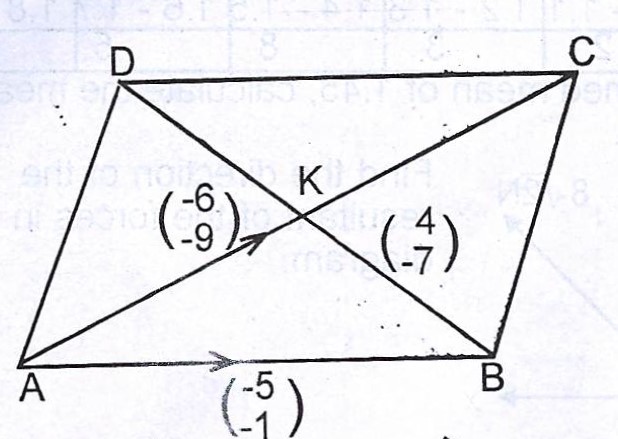 \(\overrightarrow{AB} = \begin{pmatrix} -5 \\ -1 \end{pmatrix}, \overrightarrow{AC} = \begin{pmatrix} -6 \\ -9 \end{pmatrix}\)
and \(\overrightarrow{BD} = \begin{pmatrix} 4 \\ -7 \end{pmatrix}\). Show whether or not ABCD is a parallelogram.
(a) A(-1, 2), B(3, 5) and C(4, 8) are the vertices of triangle ABC. Forces whose magnitudes are 5N and \(3\sqrt{10}\)N act along \(\overrightarrow{AB}\) and \(\overrightarrow{CB}\) respectively. Find the direction of the resultant of the forces.
(b) A particle starts from rest and moves in a straight line. It attains a velocity of 20 m/s after covering a distance of 8 metres. Calculate :
(i) its acceleration ; (ii) the time it will take to cover a distance of 40 metres.
(a) If the coefficient of \(x^{2}\) and \(x^{3}\) in the expansion of \((p + qx)^{7}\) are equal, express q in terms of p.
(b) A man makes a weekly contribution into a fund. In the first week, he paid N180.00, second week N260.00, third week N340.00 and so on. How much would he have contributed in 16 weeks?

Calculate the gradient of the curve \(x^{3} + y^{3} - 2xy = 11\) at (2, -1).
A side of a rectangle is three times the other. If the perimeter increases by 2%, find the percentage increase in the area of the rectangle.

