


(a) Differentiate \((x - 3)(x^{2} + 5)\) with respect to x.
(b) If \((x + 1)^{2}\) is a factor of \(f(x) = x^{3} + ax^{2} + bx + 3\), where a and b are constants, find the :
(i) values of a and b ; (ii) zeros of f(x).
(a) Express \(\frac{5 + \sqrt{2}}{3 - \sqrt{2}} - \frac{5 - \sqrt{2}}{3 + \sqrt{2}}\) in the form \(a + b\sqrt{2}\).
(b) Solve the following equations simultaneously using the determinant method.
\(3x - y - z = -2\)
\(x + 5y + 2z = 5 \)
\(2x + 3y + z = 0\)
(a) If \(f(x) = \frac{x - 3}{2x - 1} , x \neq \frac{1}{2}\) and \(g(x) = \frac{x - 1}{x + 1}, x \neq -1\), fing \(g \circ f\).
(b)(i) Sketch the curve \(y = 9x - x^{3}\) ; (ii) Calculate the total area bounded by the x- axis and the curve \(y = 9x - x^{3}\).

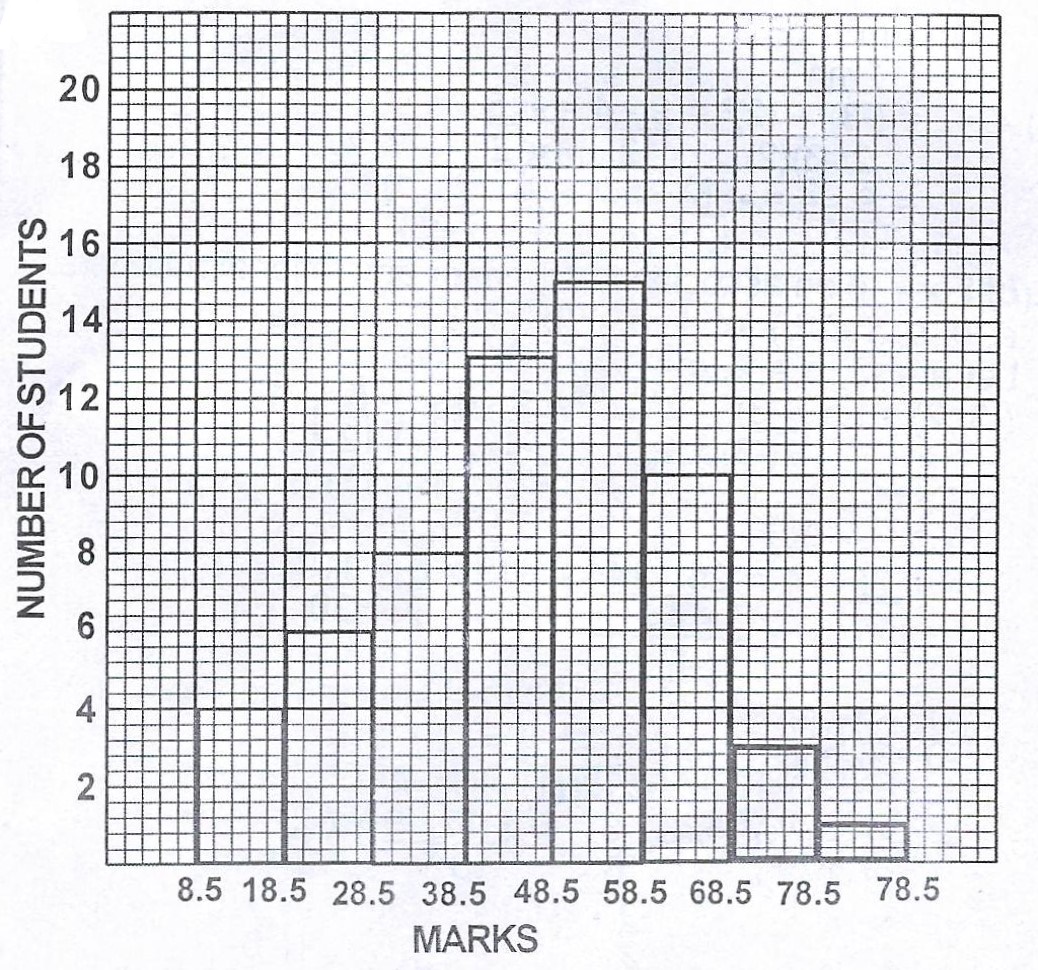
The histogram above represents the scores of some candidates in an examination.
(a) Using the histogram, construct a frequency distribution table indicating clearly the class intervals ;
(b) Draw a cumulative frequency curve of the distribution and use it to estimate the :
(i) median ; (ii) quartile deviation.
The probabilities that Kofi, Kwasi and Ama will pass a certain examination are \(\frac{9}{10}, \frac{4}{5}\) and x respectively. If the probability that only one of them will pass the examination is \(\frac{9}{50}\), find the :
(a) value of x ;
(b) probability that at least one of them will pass the examination.

