


The temperature of a glass vessel containing 100 cm\(^3\) of mercury is raised from 10°C to 100°C. Calculate the apparent cubic expansion of the mercury. (Real cubic expansivity of mercury = 1.8 × 10\(^{-4}\) K\(^{-1}\), Cubic expansivity of glass = 2.4 × 10\(^{-5}\) K\(^{-1}\))
An iron rod of mass 2 kg and at a temperature of 280°C is dropped into some quantity of water initially at a temperature of 30°C. If the temperature of the mixture is 70°C, calculate the mass of the water. (Neglect heat losses to the surroundings) [Specific heat capacity of iron = 460 Jkg\(^{-1}\)K\(^{-1}\)] [Specific heat capacity of water = 4200 Jkg\(^{-1}\)K\(^{-1}\)]
How much heat is required to convert 20 g of ice at 0°C to water at the same temperature? [Specific latent heat of ice = 336 Jg\(^{-1}\)]

When two objects, P and Q, are supplied with the same quantity of heat, the temperature change in P is observed to be twice that in Q. If the masses of P and Q are the same, calculate the ratio of the specific heat capacities of Q to P.
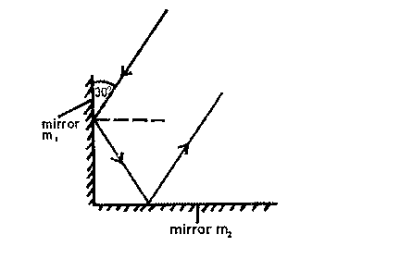
A ray of light is incident on mirror m\(_1\) and after reflection is incident on mirror m\(_2\) as shown in the diagram above. Calculate the angle of reflection of the ray at mirror m\(_2\).

