


(a) identify specimens A and B (b) (i) Name the group or class of animals to which each specimen belongs (ii) State the location of specimen B in the organism (c) State two characteristic features common to specimens A and Band which adapt them to their functions (d) What is the function of specimen A in the organism? (e) Suggest the habitats of the animals to which each of the specimens belongs (f) Make a labelled drawing 6 to 7cm long of specimen B to illustrate its essential features.
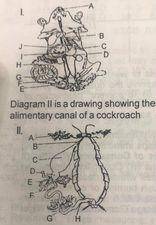
Diagram 1 is a drawing showing the alimentary canal of a mammal. Study the diagram carefully (a) Name the structure labelled A to J (b) What are the functions of the parts labelled A, C and H?
(C) Name the parts labelled A to H (d) State the functions of the parts labelled D and E (e) State two features common diagram I and D in diagram II (f) identify and name the parts in diagrams I and ll that perform similar functions

In the following experiments wash the test tube and the measuring cylinder before each use. You are provided with Solution A (a) Place three drops of solution A on a white tile and add one drop of iodine solution. Record your observation (b) Put 10cm³ of solution A in a beaker and add a few drops of dilute tetraoxosulphate (vi) acid (H\(_2\)SO\(_4\),) in a test tube and boil fora few minutes. Then add a few drops of sodium hydroxide solution and allów the mixture to cool. Divide the mixture into two equal portions
(a) What would you observe if a filament of spirogyra is immersed in 0. 1 m sodium chloride solution for about one hour?
(b) Name the process which occurred during the immersion of the spirogyra filament in 0.1 m sodium chloride solution.

