


(a) Complete the table below;
| Disease | Causative organism | Vector | Control |
| Cholera | |||
| Trypanosome | |||
| Female Anopheles mosquito | |||
| Ringworm | None |
(b) Explain briefly the biological basis of preserving foods using each of the following methods;
(i) salting (ii) irradiation (iii) smoking
(a) Explain briefly; (i) independent assortment of genes (ii) the reason blood group O in humans can only exist in homozygous form while blood groups A and B can exist both in homozygous and heterozygous forms.
(b) Complete the table below by naming the classes of vertebrates in their evolutionary trend and giving one example each of the classes.
| Classes of vertebrate | One example |
(a) Explain briefly the following types of fertilization in animals; (i) external fertilization (ii) internal fertilization
(b) Name two groups of animal each that exhibit the types of fertilization in (a)
(c)(i) If the placenta in a pregnant woman is detached from the uterine wall, give three effect this will have on the foetus
(ii) Name three other features in the uterus of a pregnant woman that are useful for the development of the foetus
(d) Explain briefly how the activities of organisms bring bout dynamic equilibrium in the habitat.
(e) State four problems that organisms in the intertidal zone of a marine habitat could encounter.
(f) Explain briefly the reasons that the following factors are necessary for germination; (i) moisture (ii) viable seeds
(g) Explain briefly the reason light energy is considered a limiting factor in the production of foods by autotrophs.
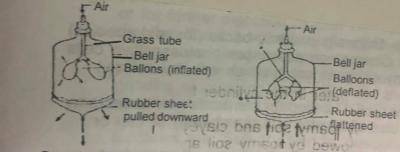
The set-up in diagrams I and II illustrate breathing mechanisms in mammals
(a) Name the structures in mammals that are equivalent in function to the parts labelled (i) glass tube (ii) bell jar (iii) balloons (iv) rubber sheets (v)A (vi) B.
(b) Name the processes illustrated by diagrams (i) I (i)
(c) In which of the bell jars is the pressure lower?
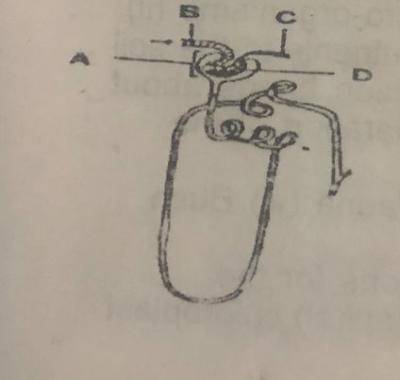
(a) Name the parts labelled A, B, C and D
(b) What is the significance of the relative size of B and C?
(c) Name the structures in: (i) Amoeba (ii) earthworm. Which are equivalent in function to the structure illustrated in the diagram


