


State three differences between magnetic and non-magnetic materials.
(a)(i) State the law of inertia.
(ii) Use the law stated in (a)(I) to explain how wearing a safety belt in a moving vehicle could reduce the possibilities of severe injuries when the vehicle is involved in a collision.
(b)(I) Define the term moment of a force.
(ii) A uniform plank measures 2 m long from its ends point A to point B. If the weight of the plank is 54 N and it rests on a knife edge 0.50 m from end B and point A is supported by a vertical string so that AB balances horizontally:
i. Draw a force diagram for the arrangement;
ii. Determine the tension, T, in the string.
iii. Determine the force, F, acting on the knife edge
(c) State three differences between solid friction and viscosity
(d) State one method of increasing the velocity ration of a pulley system.
(a)(i) State Coulomb's law of electrostatics.
(ii) The electron and proton of a hydrogen atom are separated by a mean distance of 5.2 x 10\(^{-11}\)m.
Calculate the magnitude of the electrostatic force between the particles.
[e = 1.6 x 10\(^{-19}\) C, (4\(\pi\) \(\mathcal{E}_{0}\))\(^{-1}\) = 9.0 x 10\(^{9}\) mF\(^{1}\)]
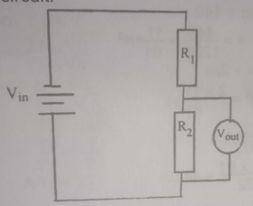
(b) The diagram above shows a potential divider circuit. (see diagram above)
i. Show that V\(_{out}\) = V\(_{in}\) (\(\frac{R_{1}}{R_{1} + R_{2}})\)
ii. If \(\frac{V_{in}}{V_{out}}\) = 2.5 and R\(_{2}\) = 30\(\Omega\), calculate R\(_{1}\)
iii. Define the volt.
(c) Explain why wood is not suitable for use as the core of transformers.
(d) State one application for the cathode ray tube.

(a) State one condition each necessary for the characteristics each of the following occurrences:
(i) Constructive interference of waves.
(ii) Total internal reflection.
(iii) Production of beats.
(b) In a resonance tube experiment using a tuning fork of frequency 256 Hz, the first position of resonance was 35 cm, the next position was 100 cm. Calculate the velocity of sound in air from the experiment.
(c)(i) State the three classifications of musical instalments
(ii) Give one example each of the classifications stated in (c)(i).
(d) Calculate the critical angle for light traveling from glass to air. [refractive index of glass = 1.5].
(e) The speed of sound in a medium at a temperature of 102 °C is 240 m s\(^{-1}\). If the speed of sound in the medium is 3 10 m s\(^{-1}\). Calculate its temperature
(a) State two factors that affect the rate of evaporation of a liquid.
(b) Explain the term latent heal.
(c) Explain each of the following phenomena:
(i) On a dry day, water in a clay pot is cooler than water in a rubber container:
(ii) Cooking of food is faster in a pressure cooker than in an ordinary pot.
(d) A 40 V electric heater is used to supply a current of 12 A for 1400 seconds to a body mass of 1.5 kg at its melting point. The body melts and its temperature rises by 60°C in an extra 1.2 minutes, Calculate the:
(i) Latent heat of fusion of the body
(ii) Specific heat capacity of the body.
(e) State two differences between evaporation and boiling.

