


a) List two properties of cathode rays.
(b) Explain how the intensity and energy of cathode rays may be increased
a) Given a retort stand and clamp, a stout pin, a simple pendulum and a pencil, describe how you would use these apparatus to determine the centre of gravity of an irregularly shaped piece of cardboard of a moderate size.
(b) Using a suitable diagram, explain how the following can be obtained from a velocity-time graph:
(i) acceleration;
(ii) total distance covered.
(c ) A body at rest is given an initial uniform acceleration of 6.0 ms\(^{-2}\) for 20s after which the acceleration is reduced to 4.0 ms\(^{-2}\) for the next 10s.
The body maintains the speed attained for 30s.
Draw the velocity-time graph of the motion using the information given above. From the graph, calculate the:
(a) Explain why it is not advisable to sterilize a clinical thermometer in boiling water at normal atmospheric pressure.
(b) State the effect of an increase in pressure on the
(i) boiling point; and
(ii) melting point of water.
(c) Diagram:
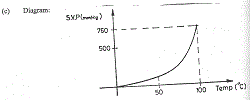
The graph shown above is that of the saturated vapour pressure (s.v.p.) of water against temperature.
Pure water is known to boil at 100\(^o\)C and at an atmospheric pressure of 760 mmHg. What general conclusion can be drawn from the information given above?
d) A thread of mercury of length 20 cm is used to trap some air in a capillary tube with uniform cross-sectional area and closed at one end. With the tube vertical and the open end uppermost, the length of the trapped air column is 15cm. Calculate the length of the air column when the tube is held:
i) horizontally;
ii) vertically with the open end underneath. [Atmospheric pressure = 76 cmHg ]
(a) State two differences between a sound wave and a radio wave.
(b) Explain why a vibrating tuning fork sounds louder when its stem is pressed against a table top than when held in air.
(c)State two conditions necessary for the:
(d) A ray of light is incident on one face of an equilateral glass prism.
(a) State two essential differences between a moving coil galvanometer and a d.c. generator.
(b) Explain the term eddy currents and state two devices in which the currents are applied.
(c) State the principle on which the potentiometer is based when it is functioning.
(d) A source of e.m.f. 110 V and frequency 60Hz is connected to a resistor, an inductor and a capacitor in series. When the current in the capacitor is 2A, the potential differences across the resistor is 80 V and that across the inductor is 40 V. Draw the vector diagram of the potential differences across the inductor, the capacitor and the resistor.
Calculate the:
(i) potential difference across the capacitor;
(ii) capacitance of the capacitor;
(iii) inductance of the inductor. [π = 3.14]


