


(a)(i) What is a thermometric liquid?
(ii) State the reason for the following design features of a clinical thermometer. I. Narrow bore: II. Thin wall of the bulb
(b) Distinguish between heat and temperature of an object in terms of the energy of a particle
(c) Explain why evaporation leads to cooling
(d) A kettle rated 2000W, contains water at 20ºC. The kettle is switched on and after two minutes, the water starts boiling. After another six minutes, 45% of the water in the kettle boils away. (i) Determine the specific latent heat of the vaporization of the water (ii) State one assumption made in your calculation 9d(i) above
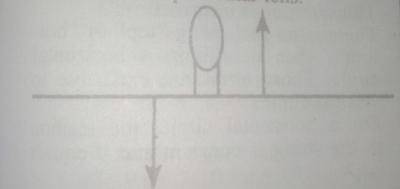
(a) State the condition for light ray incident on a concave mirror to reflect through the principal focus of the mirror.
(b) Explain spherical aberration as a defect of curved mirrors
(c) The diagram above illustrates an image formed when an object is placed in front of a particular lens. Redraw the diagram and indicate the center of curvature, C, principal focus, F, and the principal axis. ( SEE THE DIAGRAM ABOVE)
(d) What is meant by accommodation in connection to the human?
(e) State quantitatively, the (i) values of the near and far point of a normal eye. (ii) Use the answer in 10c(i) to determine the change in optical power of the normal human eye when reading a book and viewing the sky.[lens-to-retina distance = 2.5 cm].
(a)i State the condition for a charged particle to experience a force in magnetic field
(ii) State the expression for the magnetic force, F acting on a charged particle, Q in a magnetic field of flux density, \(\beta\) with speed, V
(iii) Prove quantitatively that there is no magnetic force moving along the direction of a magnetic field.
(b)i Mention the main parts of an electrical transformer.
(ii) Explain how an alternating potential difference applied to the primary coil gives rise to an induced e.m.f in the secondary coil of a transformer.
(c) Proton of mass 1.7 x 10(^{-27}\) kg enters a magnetic field of flux density 0.207 normally and followed a quarter circle path before existing with a constant speed of 4.5 x 10\(^6\)m/s
(i) Explain why the speed of the proton remains constant.
(ii) Calculate the
I. radius of the circular path
II. time taken by the proton to move through the magnetic field [e = 1.6 x 10\(^{-19}\) C, \(\pi\) = 3.14]


(a) Mention three facts about photoelectric effect
(b) An electric magnetic radiation source of power 6 x 10\(^{-3}\) W emits 1 x 10\(^{16}\) photons per second. The most energetic photo electron ejected from a metal surface is stopped by a potential difference of 2.2V. Calculate the work function of the metal. [ mass of (photon) electrons 9.1 x 10\(^{-31}\) kg, e = 1.6 x 10\(^{-19}\) C]
(c) State two factors on which the activity of a radioactive sample depends
(d) Cobalt-60 source has an activity of 2.0 x 10\(^6\) Bq and a half-life of 1.8 x 10\(^8\)s. Calculate the number of radioisotope nuclei in the source.
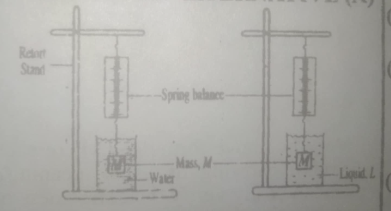
(a) You are provided a retort stand, a spring balance, masses, a beaker containing water, another beaker containing a liquid labelled, L, and other necessary apparatus.
(i) Suspend the mass, m = 20 g on the spring balance and measure the weight in air, W\(_A\) in Newton.
(ii) Immerse the suspended mass completely in water and measure weight in water, W\(_W\) in Newton. Evaluate U\(_1\) = W\(_A\) - W\(_W\).
(iii) Immerse the suspended mass completely in the liquid L of the same volume with water and measure the weight in liquid W\(_L\). Evaluate U\(_2\) = W\(_A\) - W\(_L\).
(iv) Repeat the procedure for m = 40g, 60g, 80g, and 100g respectively. In each case, evaluate \(W_A\), W\(_W\), U\(_1\), W\(_L\), U\(_2\).
(v) Tabulate the readings.
(vi) Plot a graph of U\(_1\) on the vertical axis and U\(_2\) on the horizontal axis starting both axes from the origin (0, 0).
(vii) Determine the slope s of the graph
(viii) Evaluate K = \(\frac{1}{\text{s}}\)
(ix) State two precautions taken to ensure accurate results.
b(i) State the Archimedes' principle,
(ii) State two differences between density and relative density
