Post-UTME Past Questions - Original materials are available here - Download PDF for your school of choice + 1 year SMS alerts
WAEC Past Questions, Objective & Theory, Study 100% offline, Download app now - 127076

Physics Past Questions

Clear Selections
Change Subject Post a Question Check Syllabus Study My Bookmarks Past Questions Videos Watch Video Lessons Download App

WAEC and NECO CBT Software for Computers and Laptops - Candidates, Schools, Centres, Resellers - 100% Offline -Download Now
WAEC offline past questions - with all answers and explanations in one app - Download for free
Post-UTME Past Questions - Original materials are available here - Download PDF for your school of choice + 1 year SMS alerts
46

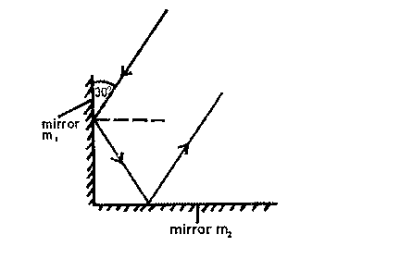
A ray of light is incident on mirror m\(_1\) and after reflection is incident on mirror m\(_2\) as shown in the diagram above. Calculate the angle of reflection of the ray at mirror m\(_2\).
  • A. 60\(^0\)
  • B. 90\(^0\)
  • C. 30\(^0\)
  • D. 120\(^0\)
View Answer & Discuss (1) WAEC 2025
47

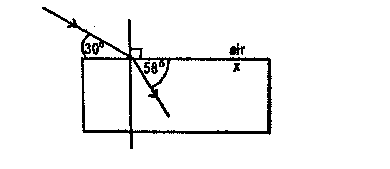
A ray of light is incident on a body x as shown in the diagram above. What is the refractive index of the body?

  • A. 1.33
  • B. 1.63
  • C. 1.50
  • D. 1.49
View Answer & Discuss WAEC 2025
48

The image of any real object formed by a diverging lens is always

  • A. magnified
  • B. inverted
  • C. erect
  • D. real
View Answer & Discuss WAEC 2025
Post UTME Past Questions Agent
WAEC and NECO CBT App for Mobile Devices - Candidates, Schools, Centres, Resellers - 100% Offline -Download Now
WAEC offline past questions - with all answers and explanations in one app - Download for free
49

2a. 

(i) Fix a metre rule on the bench with the graduated face up.

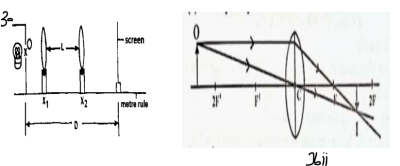
(ii) Place the illuminated object at the zero end of the rule and the screen at the other end as illustrated in the diagram above.

(iii) Measure and record D, the distance between the object and the screen. Evaluate D\(^2\)

(iv) Place and move the converging lens between the illuminated object and the screen until a diminished, sharp image of the object is formed on the screen. Read and record the position, x\(_1\), of the lens. From this position, move the lens towards the object until another sharp image of the object is formed on the screen. Read and record the position, x\(_2\), of the lens.

(v) Evaluate and record L = (x\(_1\) - x\(_2\)), L\(^2\) and (D\(^2\) - L\(^2\)).

(vi) Repeat the procedure for D = 90, 80, 70, and 60 cm. In each case, evaluate L, L\(^2\), and (D\(^2\) - L\(^2\)). Tabulate your readings.

(vii) Plot a graph of D\(^2\) - L\(^2\) on the vertical axis against D on the horizontal axis.

(viii) Determine the slope, s, of the graph and evaluate K = \(\frac{\text{s}}{4}\). State two precautions taken to ensure accurate results.[21 marks]

bi. Distinction Between Real and Virtual Images [2 marks]

ii. Draw a ray diagram to show how a converging lens may be used to form a real diminished image of an object [2 marks]


View Answer & Discuss WAEC 2025
Start a Free Practice Test
 
WAEC Past Questions, Objective & Theory, Study 100% offline, Download app now - 127076
WAEC offline past questions - with all answers and explanations in one app - Download for free
WAEC and NECO CBT App for Mobile Devices - Candidates, Schools, Centres, Resellers - 100% Offline -Download Now
Post-UTME Past Questions - Original materials are available here - Download PDF for your school of choice + 1 year SMS alerts