


(a) (i) Explain why x-rays can be used to produce photographs of fractures in bones.
(ii) List four uses of x-rays other than in medicine.
(b) State the energy transformations which takes place during the operation of an x-ray tube.
(c) (i) Explain three named dangers to which human beings may be exposed when subjected to large doses of x-rays.
(ii) State two precautions that must be taken by persons working with x-rays.
(d) In an x-ray tube, an electron is accelerated from rest towards a tungsten target biased at a potential of 33 kV. Calculate, for the electron, the
(i) kinetic energy;
(ii) velocity. [h = 6.6 x 10\(^{-14}\) Js; Me = 9.1 x10\(^{-31}\) kg; c = 3.0 x 10\(^4\) ms\(^{-1}\); e = 1.6 x 10\(^{-19}\) C.]
A spiral spring with a metal extends by 10.5 cm in air. When the metal is fully submerged in water, the spring extends by 6.8 cm. Calculate the relative density of the metal. (Assume Hooke's law is obeyed)
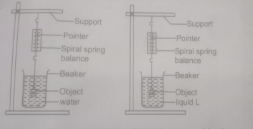
Study the diagrams above and use them as guides in carrying out the following instructions.
(b)i. State Archimedes' principle.
ii. A piece of brass of mass 20.0g is hung on a spring balance from a rigid support and completely immersed in kerosene from of density 8.0 x 10\(^{2}\)kgm\(^{-3}\). Determine the readings of the spring balance (g= 10ms\(^{-2}\), density of brass 8.0 x 10\(^{3}\)kgm\(^{-3}\))



You are provided with a syringe, a petri-dish firmly attached to the base of the movable piston (plunger) of the syringe, a Set of weights, and other necessary apparatus.
(b)i. When a weight is placed on the petri-dish, which quantities of the gas in the syringe (\(\Omega\)) increases; (\(\beta\)) decrease?
ii. What is responsible for the pressure exerted by a gas in a closed vessel?

You are provided with a potentiometer, an ammeter, a voltmeter, a standard resistor, and other necessary apparatus. Using the circuit diagram above as a guide carry out the following instructions.
(b) i. State two advantages of a lead-acid accumulator over a dry Leclanche cell.
ii. A cell of emf 2V and internal resistance of 1\(\Omega\) passes current through an external load of 9\(\Omega\). Calculate the potential drop across the cell.

