


(a) Explain wave-particle duality of light.
(b) Illustrate your answer in (a) with observable phenomena.
(a) State the principle of conservation of linear momentum.
(b) Explain the mode of action of a propelled rocket.
(c) During a training session, two footballers pass a ball repeatedly between themselves. Give two reasons why the to and fro motion of the ball is not simple harmonic.
(d) A ball is dropped from a height, at the same time as another ball is projected horizontally from the same height.
(i) Would the balls hit the ground at the same time?
(ii) Explain your answer in (i).
(e) A ball of mass 0.10 kg is projected horizontally onto a vertical wall with a speed of 17 ms\(^{-1}\). The ball makes contact with the wall for 0.15 s and rebounds horizontally with a speed of 13 ms\(^{-1}\).
Calculate the:
(i) change in momentum of the ball;
(ii) average force exerted on the ball during its collision with the wall.
(a) (i) What is a machine?
(ii) State two uses of gears.
(iii) Define the velocity ratio for a pair of gear wheels.
(iv) How can the mechanical advantage of a gear system be increased?
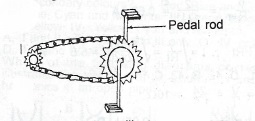
The diagram above illustrates the gears system of a bicycle.
(i) Determine its velocity ratio.
(ii) If the bicycle has an efficiency of 90%, calculate the effort required to overcome a load of 70N.
(iii) Why is the calculated effort less than the actual effort required?

(a) Explain the term critical angle.
(b) List two factors which determine the deviation of a ray of light by a triangular glass prism.
(c) The angle of refraction (r) of a ray of white light from air through a triangular glass prism of refractive index 1.5 is 29.0°. Calculate the angle through which the ray is least deviated.
(d) Study the ray diagram below and use it to answer the questions that follow.
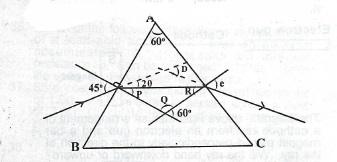
Calculate the:
(i) values of angles P,Q and R;
(ii) refractive index n of the glass prism;
(iii) value of e;
(iv) total deviation D.
(a) Define magnetic line of force.
(b) A wire of length 10 cm carrying a current of 4.0 A is placed between the poles of a powerful electromagnet of magnetic flux density 2.0 T. Calculate the:
(i) force on the wire when it is parallel to the field;
(ii) maximum force on the wire;
(iii) force on the wire when it makes an angle of 60° with the field.
(c) Describe how keepers can be used to preserve the magnetic strength of permanent bar magnets.
(d) A sailor observes that his mariners' compass reads N 10° W at a place where the angle of declination is N15° W. Calculate the true bearing of the place.


