

Post-UTME Past Questions - Original materials are available here - Download PDF for your school of choice + 1 year SMS alerts
WAEC and NECO CBT App for Mobile Devices - Candidates, Schools, Centres, Resellers - 100% Offline -Download Now

Physics 2009 WAEC Past Questions

Clear Selections
Change Subject Post a Question Check Syllabus Study My Bookmarks Past Questions Videos Watch Video Lessons Download App

WAEC Past Questions, Objective & Theory, Study 100% offline, Download app now - 127076
Post UTME Past Questions Agent
WAEC offline past questions - with all answers and explanations in one app - Download for free
61

Open Photo
 

  1. You are provided with two meter rules and other necessary apparatus.
  2. Place one of the rules on a knife edge and determine its centre of gravity C. Mark this pos with a piece of chalk.
  3. Read and record the mass M\(_{R}\) of the metre rule written on the reverse side of it.
  4. Attach the mass M= 100g firmly to the rule AB at C using sellotape.
  5. Suspend the metre rule by two parallel threads of length h = 40 cm each at the 10 cm marks. Ensure that the graduated face to the metre rule is facing upwards.
  6. Set the rule AB into a small angular oscillation about the vertical axis through its centre of gravity.
  7. Determine the time, t for 20 complete oscillations. Evaluate the period T and T\(^{2}\)
  8. Read and record the value of d in meters.
  9. Keeping d constant throughout the experiment, repeat the procedure for other values of h = 50, 60, 70, and 80 cm. In each case determine the corresponding values of f T and T. Tabulate your reading. (x) Plot a graph of T on the vertical axis and h on the horizontal axis.
  10. Determine the slope S, of the graph. Evaluate k =s, where Q =2 S, Q 250P
  11. State two precautions taken to ensure accurate results.

(b)i. Define the term couple as it relates to rotational or oscillatory systems.

ii. Give two practical application of a couple in everyday life.


View Answer & Discuss WAEC 2009
62

Open Photo
 

  1. You are provided with a measuring cylinder, two different tins labeled C and D, a thermometer, and other necessary materials.
  2. Use the measuring cylinder provided to measure 100 cm of water and pour it into the tin label.
  3. Heat the water in the tin almost to boiling (90°C).
  4. Remove the tin and place it on a cork or wooden stand.
  5. Insert the thermometer into the tin and record the temperature of the water every minute starting from 85°C until the temperature falls to 60°C.
  6. Repeat the experiment with the tin labeled D using exactly the same volume of water and temperature range. Tabulate your readings.
  7. On the same graph sheet and using the same axis and scales, plot two graphs of temperature on the vertical axis and time on the horizontal axis from the readings obtained using tins C and D.
  8. Label the graphs appropriately as C and D to correspond with the tins used.
  9. From each graph, read off the time taken to cool from 85°C to 65°C.
  10. State two precautions taken to ensure accurate results. 

(b)i. Explain how heat losses by radiation and convection are minimized in a vacuum flask.

ii. State four factors that affect the rate of evaporation of a liquid in an open container.
 

View Answer & Discuss WAEC 2009
63

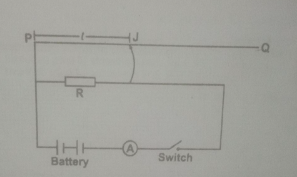
1. Connect the circuit as shown in the diagram above. PQ is a potentiometer wire 100 cm long and R is a standard resistor of 5\(\Omega\).

2. With the jockey J not making contact with PQ, close the switch. Read and record the ammeter reading I. Open the switch.

3. Use the jockey to make contact with PQ at the 20cm mark such that PJ = I = 20 cm. Close the switch, read and record the value I\(_{i}\) of the ammeter. Evaluate I\(^{-1}\).

4. Repeat the procedure for other values of I = 35, 50, 65, and 80 cm. In each case, determine the corresponding values of I\(_{i}\), and I\(^{-1}\). Tabulate your readings.

  1. Plot a graph of I\(^{i}\) on the vertical axis and I\(_{i}\), on the horizontal axis, starting both axes from the origin (0, 0).
  2. From your graph deduce the value, of I\(_{o}\) of I\(_{i}\), when I\(^{-1}\)= 0.
  3. Evaluate I\(_{o}\)e
  4.  State two precautions taken to ensure accurate results. 

(b)) Define the e. m.f. of a battery

ii. A cell e.m.f. 1.00 V is balanced by a length of 40.0 cm on a potentiometer wire. Another cell Y is balanced by a length of 60.0 cm on the same wire. Calculate the e.m.f. of Y.

View Answer & Discuss (2) WAEC 2009
WAEC and NECO CBT App for Mobile Devices - Candidates, Schools, Centres, Resellers - 100% Offline -Download Now
Post-UTME Past Questions - Original materials are available here - Download PDF for your school of choice + 1 year SMS alerts
Post UTME Past Questions Agent
Start a Free Practice Test
 
WAEC and NECO CBT App for Mobile Devices - Candidates, Schools, Centres, Resellers - 100% Offline -Download Now
WAEC and NECO CBT Software for Computers and Laptops - Candidates, Schools, Centres, Resellers - 100% Offline -Download Now
Post-UTME Past Questions - Original materials are available here - Download PDF for your school of choice + 1 year SMS alerts
WAEC Past Questions, Objective & Theory, Study 100% offline, Download app now - 127076
