Post UTME Past Questions Agent
Post-UTME Past Questions - Original materials are available here - Download PDF for your school of choice + 1 year SMS alerts

Physics 2007 WAEC Past Questions

Clear Selections
Change Subject Post a Question Check Syllabus Study My Bookmarks Past Questions Videos Watch Video Lessons Download App

Your School's Whatsapp Group - Join Us now
WAEC and NECO CBT Software for Computers and Laptops - Candidates, Schools, Centres, Resellers - 100% Offline -Download Now
WAEC and NECO CBT App for Mobile Devices - Candidates, Schools, Centres, Resellers - 100% Offline -Download Now
61

(a)(i) What is a wave motion?

(ii) State two differences between a radio wave and a sound wave.

(b)(i) Given that you are provided with a tuning fork, a burette and other necessary apparatus, describe with the aid of a diagram, an experiment to determine the frequency of a note emitted by a source of sound. [assume the velocity of sound in air is known]

(ii)State two precautions necessary to obtain accurate result in the experiment described in (b)(i) above

(c) A pipe closed at one end is 100 cm long. If the air in the pipe is set into vibration and a fundamental note is produced, calculate the frequency of the note. [ velocity of sound in air = 340 ms\(^{-1}\)]

View Answer & Discuss WAEC 2007
62

(a) With the aid of a simple diagram, explain how a step down transformer works.

(b)(i) State three ways by which energy is lost in a transformer

(ii) Mention how each of the losses in (b)(i) above can be minimized

(c) A 95% efficient transformer is used to operate a lamp rated 60W, 220 V from a 4400 V a.c supply. Calculate the;

(i) ratio of the number of turns in the primary coil to the number of turns in the secondary coil of the transformer

(ii) current taken from the main circuit.

View Answer & Discuss WAEC 2007
63

(a)(i) With the aid of a labelled diagram describe the mode of operation of a modern X-ray tube.

(ii)State the energy transformations that take place during the operation of the X-ray tube.


(b) Define, as applied to X-rays, the following terms:

(i) hardness;

(ii) intensity.


(c) State (i) four uses of X-rays;

(ii) one hazard of over-exposure to X-rays in a radiological laboratory.

View Answer & Discuss WAEC 2007
WAEC and NECO CBT Software for Computers and Laptops - Candidates, Schools, Centres, Resellers - 100% Offline -Download Now
Your School's Whatsapp Group - Join Us now
Post-UTME Past Questions - Original materials are available here - Download PDF for your school of choice + 1 year SMS alerts
64

Open Photo

You are provided with a retort stand, clamp and boss, a pendulum bob, a piece of thread, and other necessary apparatus. Carry out the fo lowing experiment:

  1. Set up the apparatus as shown in the diagram above:
  2. measure and record the distance = 130cm from the centre of the bob to the point of suspension of the pendulum
  3. displace the pendulum through a small angle and release. Allow the pendulum to oscillate freely;
  4. determine the time t for 20 complete oscillations;
  5. also, determine the period T of the oscillations
  6. evaluate T\(^{2}\) and L = -30;
  7. repeat the procedure for four other values of l = 110, 90, 70, and 50 cm
  8. in each case, determine t and evaluate T,T\(^{2}\) and L. Tabulate your readings.
  9. plot of a graph of T\(^{2}\) on the vertical axis against L on the horizontal axis, starting both axes from the origin (0,0)
  10. determine the slope, s, of the graph. Also determine the intercept, C, of the graph on the T\(^{2}\) axis;
  11. evaluate: i. k\(_{1}\) = \(\frac{4\pi^{2}}{s_{1}}\),
                   ii.  k\(_{2}\) = \(\frac{c}{8}\) [Take \(\pi\) = \(\frac{22}{7}\)]
  12. state two precautions taken to ensure accurate results.

(b)i. What is meant by the period of oscillation of an oscillating body?

i. Explain the acceleration of free fall due to gravity.
View Answer & Discuss (1) WAEC 2007
65

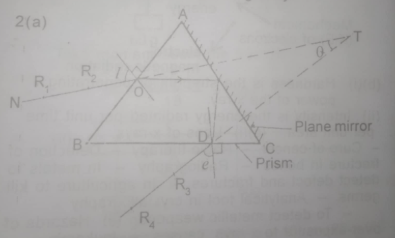
Using the above diagram as a guide, carry out the following experiment:

  1. Place the equilateral triangular glass prism on the drawing paper. Trace the outline ABC of the prism.
  2. remove the prism. Draw a line NO such that it makes an angle = 25º with the normal at point O on side AB
  3. fix two pins R\(_{1}\) and R\(_{2}\) vertically on line N0. Replace the prism on its outline;
  4. place the reflecting surface of the plane mirror in contact with the face AC of the prism;
  5. looking through the face BC of the prism, fix two other pins at R\(_{3}\) and R\(_{4}\) such that the pins appear to be in a straight line with the images of the pins at R\(_{1}\) and R\(_{2}\);
  6. remove the prism, the mirror, and the pins. Draw a line to join points R\(_{4}\) and R\(_{3}\)
  7. produce line R\(_{4}\)R\(_{3}\) to meet line NO produced at T;
  8. measure and record the angle \(\theta\) at T and e at D;
  9. repeat the procedure for four other values of = 30°, 35°, 40°, and 45°. In each case, measure and record the corresponding values of \(\theta\) and e. Tabulate your readings;
  10. plot a graph of e on the vertical axis and \(\theta\) on the horizontal axis;
  11. evaluate k = s\(^{-1}\) 
  12. state two precautions taken to ensure accurate results. [Attach your traces to your answer booklet]

(b)i. State four characteristics of the image of an object formed by a plane mirror.

ii. State two Conditions necessary for total internal reflection to occur in a medium.

View Answer & Discuss (1) WAEC 2007
Start a Free Practice Test
 
Post UTME Past Questions Agent
WAEC and NECO CBT App for Mobile Devices - Candidates, Schools, Centres, Resellers - 100% Offline -Download Now
Your School's Whatsapp Group - Join Us now
Post-UTME Past Questions - Original materials are available here - Download PDF for your school of choice + 1 year SMS alerts
