


(a) Explain how a gas can be made to conduct electricity.
(b) Name the electric charge carriers in gases.
(a) State two properties of cathode rays.
(b) Explain how the intensity and energy of cathode rays may be increased.
(a) The mass and wavelength of a moving electron are 9.0 x 10\(^{-31}\) kg and 1.0 x 10\(^{-10}\)m respectively. Calculate the kinetic energy of the electron. [ h = 6.6 x 10\(^{-34}\) Js]


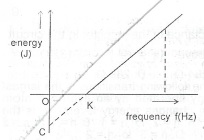
The above reprt the graph electron energy against the frequency of the radiation incident on a metal surface. lnterprete the;
(i) slope of the graph;
(ii) intercept, OC;
(iii) intercept, OK.
(a) Distinguish between stress and strain as used in elasticity.
(b) When a force of 40 N is applied to the free end of an elastic cord, an extension of 5cm is produced in the cord. Calculate the work done on the cord.
