


An electron of mass 9. 1 x 10\(^{-31}\) kg moves with a velocity of 4.2 x 10 ms\(^{-1}\) between the cathode and anode of an x-ray tube. Calculate the wavelength. (Take Planck's constant h = 6.6 x 10\(^{-34}\) J S)
(a)(i) Define the term linear momentum.
(ii) State the law of conservation of linear momentum.
(b) A ball P of mass 0.25 kg, loses one-third of its velocity when it makes a head on collision with an identical ball Q at rest. After the collision, Q moves off with a speed of 2ms\(^{-1}\) in the original direction of P. Calculate the initial velocity of R
(c)(i) State Newton's second law of motion.
(ii) Show that F = ma where F is the magnitude of the force acting on a body of mass m to give it an acceleration of magnitude a.
(iii) The engine of a vehicle moves it forward with a force of 9600 N against a resistive force of 2200 N. If the mass of the vehicle is 3400 kg, calculate the acceleration produced.
(a)(i) Mention two modes of heat transfer other than convection.
(ii) Explain land and sea breezes.
(b) An iron rod of length 30cm is heated through 50 kelvin. Calculate its increase in length. (linear expansivity of iron = 1.2 x 10\(^{-5}\)K\(^{-1}\)
(c) An electric heater immersed in some water raises the temperature of the water from 40°C to 100°C in 6 minutes. After another 25 minutes, it is noticed that half the water has boiled away. Neglecting heat losses to the surrounding, calculate the specific latent heat of vaporisation of water.
(a)(i) State the laws of refraction of light.
(ii) Describe an experiment to determine the refractive index, n, of the material of an equilaleral triangular glass prism using the minimum deviation method.
(b) A rectangular glass prism of thickness 12cm is placed on a mark on a piece of paper resting on a horizontal bench:
(i) Draw a ray diagram to show the apparent position of the mark in the glass prism.
(ii) If the refractive-index of the material of the prism is 1.5, calculate the apparent displacement of the mark.
(a) Define the following terms:
(i) Electric field intensity
(ii) Electric potential
(b) The diagram below illustrates two collinear electric charges of magnitudes + Q and -Q. The charges are equidistant from a point P at which a rest charge is placed.
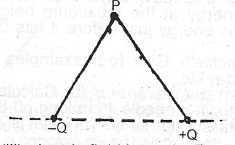
Copy the diagram and use arrows to indicate, from the point P, the direction of the;
(i) electric force F\(_1\) due to + Q.
(ii) electric force F\(_2\) due to -Q.
(iii) electric field intensity E.
(c) What is meant by dielectric substance?
(ii) List the factors which determine the capacitance of a parallel plate capacitor and state the effect each of them has on the capacitance.The diagram above represents a section of a circuit. Calculate the effective capacitance in the section.
(iii)
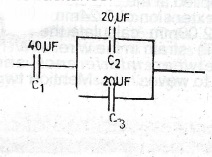
The diagram above represents a section of a circuit. Calculate the effective capacitance in the section.


