


(a) Explain the term photoelectric effect.
(b)
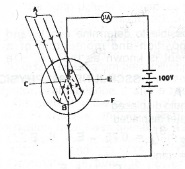
The diagram above represents a photocell with its associated electric circuit. Identify each of the physical quantities
represented by the letters A, B, C, D, E and F
(c) What factor determines the: (i) current produced by the photocell
(ii) maximum kinetic energy of the photoelectrons?
(d) State one similarity and one difference between photoemission and evaporation
(e) Name two methods by which a beam of free electrons may be produced other than photoemission
(f) State two applications of photoelectric effect.
(g) A light wavelength 5.0 x 10\(^{-7}\) m is incident on metal resulting in photoemission of electrons. If the work function of the metal is 3.04 x 10\(^{-19}\)J, calculate the:
(i) frequency of the light
(ii) energy of the incident photon,
(iii) maximum kinetic energy of the photoelectrons (Speed of light = 3.00 x 10⁸ms\(^{-1}\); Planck's constant = 6.6 x 10\(^{-34}\)Js).

You are provided with a uniform metre rule, a knife edge and a body m of mass 50g. Suspend the given body m by means of a thread from 1.0cm mark of the metre rule. Balance the loaded metre rule on the knife-edge as shown in the diagram above. Determine and record the value of x when the metre rule is in horizontal equilibrium. Evaluate \(\frac{1}{x}\). Repeat the experiment for values of m = 70, 90, 110, 130 and 150g respectively. In each case, determine and record the corresponding values of x and \(\frac{1}{x}\). Tabulate your readings. Plot a graph of m on the vertical axis and \(\frac{1}{x}\) on the horizontal axis, starting both axes from the origin (0,0). Determine the slope s, of the graph and the value of m for which /\(\frac{1}{x}\) = 0. State two precautions taken to ensure accurate results.
(b)i. Using your graph, determine the value of x for which m = 0.
(ii) State two conditions necessary to maintain the metre rule in the experiment above, in equilibrium.
(iii) Using your graph, determine the value of x for which m = 100g.

Trace the outline PQRS of the glass block on a sheet of paper, as shown in the diagram. Remove the block Mark a position 0 very close to P. Draw the normal NOG From point G, measure and mark out Points B\(_{1}\) B\(_{2}\) B\(_{3}\) B\(_{4}\) and B\(_{5}\) along with line GR at distances 1, 2, 3, 4 and 5cm respectively from G. Replace the glass block on the outline PORS Erect a pin at 0 and another at B\(_{1}\). Now fx a pin at T\(_{1}\) such that the pins at T\(_{1}\) and B\(_{1}\) are in line with the pin at O when viewed through the side SR of the glass block. Remove the glass block. Join the line OB\(_{1}\) and B\(_{1}\)T\(_{1}\). Measure and record the angles x and y. Evaluate sin x and y. Repeat the experiment with the pin at B\(_{1}\) fixed at B\(_{2}\), B\(_{3}\), B\(_{4}\) and B\(_{5}\) respectively while the pin at O remains unaltered. In each case, measure and record the values of x, y, sin x, and cos y. Tabulate your readings. Plot a graph of sin x on the vertical axis and cos y on the horizontal.axis, starting both axes from the origin (0,0). Calculate the slope, s of the graph. Evaluate K= \(\frac{1}{s}\). State two precautions taken to ensure accurate results. [Attach your tracings to your answer booklet]
(b)i. State Snell's law of refraction and explain why reaction Occurs at the boundary between two media.
ii. Differentiate refraction from diffraction.
iii. State two conditions necessary for total internal reflection to occur in a medium.


Connect the circuit as shown above. Set the value of R= 30\(\Omega\). Close the key and obtain a balance at point T on the potentiometer wire PQ. Read and record the length TQ = L Evaluate L\(^{-1}\) and R\(^{-1}\), Repeat the experiment for R= 20, 10.5, 3 and 1\(\Omega\) respectively. In each case, determine and record the corresponding values of LL\(^{-1}\) and R\(^{-1}\). Remove the resistance box from the circuit and then determine the length L\(_{o}\) corresponding to R= 0. Tabulate your readings. Plot a graph at R\(_{1}\) on the vertical axis, and L\(^{-1}\) on the horizontal axis, starting both axes from the origin (0,0). Determine the slope, s of the graph and its intercept, I on the vertical axis.
Evaluate: (i) k = 1\(^{-1}\)
(ii) \(\frac{Lo}{S}\)
State two precautions taken to ensure accurate result
(b)i. Using your graph, determine the value of L for which R =15\(\Omega\).
ii. if the intercept I = 0.5+ y\(^{-1}\), use your graph to determine the value of y.
iii. Explain what is meant by the e.m.f.of a cell.

