WAEC and NECO CBT App for Mobile Devices - Candidates, Schools, Centres, Resellers - 100% Offline -Download Now
Post-UTME Past Questions - Original materials are available here - Download PDF for your school of choice + 1 year SMS alerts

Physics WAEC Past Questions

Clear Selections
Change Subject Post a Question Check Syllabus Study My Bookmarks Past Questions Videos Watch Video Lessons Download App

Your School's Whatsapp Group - Join Us now
WAEC and NECO CBT Software for Computers and Laptops - Candidates, Schools, Centres, Resellers - 100% Offline -Download Now
WAEC and NECO CBT App for Mobile Devices - Candidates, Schools, Centres, Resellers - 100% Offline -Download Now
2031

You are provided with two resistance wires labeled A and B, a1\(\Omega\) standard resistor Rx, and other necessary apparatus.

  1. Connect R\(_{x}\) in the left-hand gap of the metre bridge, a length L= 100cm of wire A in the right-hand gap, and the other apparatus as shown in the diagram above.
  2. Determine and record the balance point P on the bridge wire NQ.
  3. Measure and record l\(_{x}\) = NP and l\(_{y}\) = PQ.
  4. Evaluate R\(_{1}\) = \(\frac{I_{y}}{L_{x}}\) = R\(_{x}\)
  5. Repeat the procedure for four other values of L= 95, 85, 75 and 65cm. In each case, determine and record the balance point P and the length l\(_{x}\) and l\(_{y}\). Also, evaluate R\(_{1}\).
  6. Repeat the experiment with the second wire B. Obtain the balance points P and the values of and l\(_{x}\) and l\(_{y}\).
  7. Evaluate R\(_{1}\) = \(\frac{I_{y}}{L_{x}}\) = R\(_{x}\) in each case. Tabulate your readings.
  8. Plot a graph of R\(_{2}\) on the vertical axis against R\(_{1}\) on the horizontal axis.
  9. Determine the slope, s, of the graph.
  10. Evaluate k = \(\sqrt s \).
  11. State two precautions taken to obtain accurate results.

(b)i. State two advantages of using a potentiometer over a voltmeter for measuring the potential difference.

ii. Define the internal resistance of a cell.

View Answer & Discuss (1) WAEC 2008
2032

Open Photo

You are provided with a retort stand, clamp and boss, a pendulum bob, a piece of thread, and other necessary apparatus. Carry out the fo lowing experiment:

  1. Set up the apparatus as shown in the diagram above:
  2. measure and record the distance = 130cm from the centre of the bob to the point of suspension of the pendulum
  3. displace the pendulum through a small angle and release. Allow the pendulum to oscillate freely;
  4. determine the time t for 20 complete oscillations;
  5. also, determine the period T of the oscillations
  6. evaluate T\(^{2}\) and L = -30;
  7. repeat the procedure for four other values of l = 110, 90, 70, and 50 cm
  8. in each case, determine t and evaluate T,T\(^{2}\) and L. Tabulate your readings.
  9. plot of a graph of T\(^{2}\) on the vertical axis against L on the horizontal axis, starting both axes from the origin (0,0)
  10. determine the slope, s, of the graph. Also determine the intercept, C, of the graph on the T\(^{2}\) axis;
  11. evaluate: i. k\(_{1}\) = \(\frac{4\pi^{2}}{s_{1}}\),
                   ii.  k\(_{2}\) = \(\frac{c}{8}\) [Take \(\pi\) = \(\frac{22}{7}\)]
  12. state two precautions taken to ensure accurate results.

(b)i. What is meant by the period of oscillation of an oscillating body?

i. Explain the acceleration of free fall due to gravity.
View Answer & Discuss (1) WAEC 2007
2033

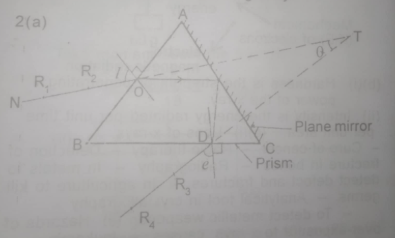
Using the above diagram as a guide, carry out the following experiment:

  1. Place the equilateral triangular glass prism on the drawing paper. Trace the outline ABC of the prism.
  2. remove the prism. Draw a line NO such that it makes an angle = 25º with the normal at point O on side AB
  3. fix two pins R\(_{1}\) and R\(_{2}\) vertically on line N0. Replace the prism on its outline;
  4. place the reflecting surface of the plane mirror in contact with the face AC of the prism;
  5. looking through the face BC of the prism, fix two other pins at R\(_{3}\) and R\(_{4}\) such that the pins appear to be in a straight line with the images of the pins at R\(_{1}\) and R\(_{2}\);
  6. remove the prism, the mirror, and the pins. Draw a line to join points R\(_{4}\) and R\(_{3}\)
  7. produce line R\(_{4}\)R\(_{3}\) to meet line NO produced at T;
  8. measure and record the angle \(\theta\) at T and e at D;
  9. repeat the procedure for four other values of = 30°, 35°, 40°, and 45°. In each case, measure and record the corresponding values of \(\theta\) and e. Tabulate your readings;
  10. plot a graph of e on the vertical axis and \(\theta\) on the horizontal axis;
  11. evaluate k = s\(^{-1}\) 
  12. state two precautions taken to ensure accurate results. [Attach your traces to your answer booklet]

(b)i. State four characteristics of the image of an object formed by a plane mirror.

ii. State two Conditions necessary for total internal reflection to occur in a medium.

View Answer & Discuss (1) WAEC 2007
WAEC and NECO CBT Software for Computers and Laptops - Candidates, Schools, Centres, Resellers - 100% Offline -Download Now
WAEC and NECO CBT App for Mobile Devices - Candidates, Schools, Centres, Resellers - 100% Offline -Download Now
Post-UTME Past Questions - Original materials are available here - Download PDF for your school of choice + 1 year SMS alerts
2034

Open Photo


You have been provided with an accumulator E, a standard resistor Rx, two resistance boxes RB\(_{1}\) and RB\(_{2}\), two keys K\(_{1}\) and K\(_{2}\) and other necessary apparatus.

  1. Measure and record the e.m.f of the accumulator.
  2. Connect a circuit as shown above.
  3. Set the resistance R, in the resistance box such that R in RB\(_{1}\) = R in RB\(_{2}\) = 1\(\Omega\).
  4. With K\(_{1}\) open and K\(_{2}\) closed, measure and record the potential difference V across the standard resistor Rx. (v) Close K, and K,. Read and record the potential difference V\(_{o}\) across Rx.
  5. Evaluate V\(_{1}^{-1}\)
  6. Repeat procedure (v) for four other values of R = 2, 3, 4 and 5\(\Omega\) respectively. In each case, ensure that the value of R in RB\(_{1}\) is equal to the value of R in RB\(_{2}\).
  7. Evaluate V\(_{1}^{-1}\) in each case. Tabulate your readings.
  8. Plot a graph of V\(_{1}^{-1}\) on the vertical axis against R on the horizontal axis starting both axes from the origin (0,0).
  9. Determine the slope, s, of the graph and the intercept on the vertical axis.
  10. Evaluate y = \(\frac{1}{s}\)
  11.  State two precautions taken to ensure accurate results

(b)i. Explain what is meant by the potential difference between two points in an electric circuit

ii. A cell has an e.m.f. of 3 V. When it is connected across a resistor of resistance 4\(\Omega\), a current 0.5A passes through the circuit. Calculate the internal resistance of the cell.

View Answer & Discuss WAEC 2007
2035

Open Photo


You have been provided with a metre rule, a clamp, and a set of masses.

  1. Clamp the metre rule to the edge of the bench such that 90cm of the rule projects from the edge as shown in the diagram above. Ensure that the rule is capable of performing oscillatory motion.
  2. Fix a mass M = 50g at the free end of the rule.
  3. Deflect the rule slightly such that it performs vertical oscillation.
  4. Determine the time t for 10 complete oscillations.
  5. Calculate the period T of the oscillations and evaluate T\(^{2}\)
  6. Repeat the procedure for four other values of M = 100, 150, 200, and 250g. In each case determine and record the corresponding values of t, T, and T\(^{2}\). Tabulate your readings.
  7. Plot a graph of T\(^{2}\) on the vertical axis against M on the horizontal axis, starting both axes from the origin (0,0).
  8. Determine the slopes, of the graph and its intercept C on the vertical axis.
  9. Evaluate k = 4\(\pi\)/s. [Take \(\pi\) = \(\frac{22}{7}\)].
  10. From your graph, determine the period T, when M= 180g.
  11. State two precautions taken to ensure accurate results.

(b)i. Explain simple harmonic motion.

ii. Define period and frequency, with respect to a simple harmonic motion.

Precautions:

  • l ensured that the metre rule was firmly clamped
  • Readings were repeated
  • Parallax was avoided when readings on the stopwatch/clock were taken.
  • zero error was noted and corrected on the stopwatch/clock.


(b)i. Simple harmonic motion is a motion in which the acceleration is proportional to the displacement from a fixed point and is directed towards the point.

ii. Period is the time taken by an oscillatory body to make one complete oscillation.

Frequency: is the number of complete oscillations performed in one second.

View Answer & Discuss WAEC 2006
Start a Free Practice Test
 
Your School's Whatsapp Group - Join Us now
Post UTME Past Questions Agent
Post-UTME Past Questions - Original materials are available here - Download PDF for your school of choice + 1 year SMS alerts
WAEC and NECO CBT Software for Computers and Laptops - Candidates, Schools, Centres, Resellers - 100% Offline -Download Now
