Your School's Whatsapp Group - Join Us now
Post UTME Past Questions Agent

Physics WAEC Past Questions

Clear Selections
Change Subject Post a Question Check Syllabus Study My Bookmarks Past Questions Videos Watch Video Lessons Download App

Your School's Whatsapp Group - Join Us now
Post UTME Past Questions Agent
WAEC and NECO CBT Software for Computers and Laptops - Candidates, Schools, Centres, Resellers - 100% Offline -Download Now
2021

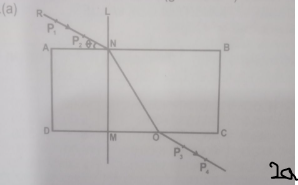
Use the diagram above as a guide to carry out the following experiment.

  1. Trace the outline ABCD of the rectangular glass prism on the drawing paper provided.
  2. Remove the prism. Select a point N on AB such that AN is about one-quarter of AB.
  3. Draw the normal LNM. Also, draw a line RN to make an angle \(\theta\) = 75° with AB at N.
  4. Fix two pins at P\(_{1}\) and P\(_{2}\) on line RN. Replace the prism on its outline.
  5. Fix two other pins at P\(_{3}\) and P\(_{4}\) such that they appear to be in a straight line with the images of the pins at P\(_{1}\) and P\(_{2}\) when viewed through the prism from DC.
  6. (vi) Remove the prism and the pins at P\(_{3}\) and P\(_{4}\). Draw a line to join P\(_{3}\) and P\(_{4}\) 
  7. Produce line P\(_{4}\) P\(_{3}\) to meet the line DC at O. Draw a line to join NO.
  8. Measure and record the values of MO and NO.
  9. Evaluate \(\theta\) = \(\frac{MO}{NO}\) and cos \(\theta\).
  10. Repeat the procedure for four other values of \(\theta\) = 65° 55°, 45°, and 35°. In each case, evaluate \(\theta\) and cos \(\theta\).
  11. Tabulate your readings.
  12. Plot a graph with cos \(\theta\) on the vertical axis and \(\theta\) on the horizontal axis.
  13. Determine the slope, s, of the graph.
  14. State two precautions taken to ensure accurate results

(b)i. State Snell's law of refraction.

ii. Calculate the critical angle for the glass prism used in the experiment above if its refractive index is 1.5.

View Answer & Discuss (7) WAEC 2011
2022

Open Photo

You are provided with cells, a potentiometer, an ammeter, a voltmeter, a bulb, a key, a jockey, and other necessary materials.

  1. Measure and record the emf E of the battery. 
  2. Set up a circuit as shown in the diagram above.
  3. Close the key K and use the jockey to make a firm contact at J on the potentiometer wire such that PJ = x = 10cm.
  4. Take the record of the voltmeter reading V and the corresponding ammeter reading I.
  5. Evaluate log V and log I.
  6. Repeat the procedure for other values of x =20, 30. 40, 50, and 60cm.
  7. Tabulate your readings.
  8. Plot a graph with the log I on the vertical axis and log V on the horizontal axis.
  9. Determine the slope, s, of the graph.
  10. Determine the intercept, c, on the vertical axis.
  11. State two precautions taken to ensure accurate results.

(b)i. How is the brightness of the bulb affected as x increases? Give a reason for your answer.

ii. List two electrical devices whose actions do not obey ohm's law

View Answer & Discuss WAEC 2011
2023

Open Photo


You are provided with three retort stands, a pendulum bob, a drawing board, a stopwatch, and other necessary apparatus. Using the diagram above as a guide, carry out the following instructions.

  1. Fix the drawing paper on the drawing board and hold the board with two clamps such that it is vertical.
  2. Suspend the pendulum bob such that it hangs freely in front of the drawing paper.
  3. Draw a line RP representing the rest position of the pendulum string and mark the position P of the centre of the pendulum bob at rest.
  4. Displace the pendulum bob to one side in a plane parallel to the drawing board.
  5. Mark the new position P\(^{1}\) of the centre of the bob.
  6. Measure and record the perpendicular distance, d of P\(^{1}\) from the line RP
  7. Evaluate and record d\(^{2}\).
  8. Measure and record the vertical height h of P\(^{1}\) above P.
  9. Evaluate G =\(\frac{d^{2}}{h}\)
  10. Repeat the procedure for four other positions of P\(^{1}\).
  11. Tabulate your readings.
  12. Remove the drawing board so that the pendulum bo can swing freely.
  13. Set the pendulum bob oscillating through a small bob amplitude and determine the time, t for 20 oscillations.
  14. Determine and record the period, T.
  15. Plot a graph with G on the vertical axis and h on the horizontal axis, starting both axes from the origin (0,0).
  16. Determine the intercept I on the horizontal axis.
  17. Evaluate A = \(\frac{1}{19.7T^{2}}\)
  18. State two precautions taken to obtain accuratee results. (Attach your drawing paper to your answer booklet.)

(b)i. Distinguish between the period and frequency of oscillation of a simple pendulum.

ii. Differentiate between oscillatory and rotational motions.
View Answer & Discuss WAEC 2010
WAEC and NECO CBT Software for Computers and Laptops - Candidates, Schools, Centres, Resellers - 100% Offline -Download Now
Your School's Whatsapp Group - Join Us now
Post UTME Past Questions Agent
2024

You are provided with a glass block, a plane mirror, and optical pins.

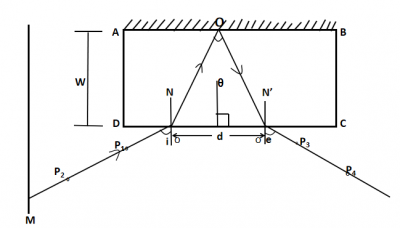
  1. Place the glass block on a drawing sheet and trace its outline ABCD as shown in the diagram above.
  2. Remove the block, measure, and record the width W of the block.
  3. Draw a normal ON to DC at a point about one-quarter the length of DC.
  4. Draw a line making an angle i = 10° with the normal.
  5. Replace the block on its outline and mount the plane mirror vertically behind the block such that it makes good contact with the face AB.
  6. Stick two pins P\(_{1}\) and P\(_{2}\) on the line MO.
  7. Looking through the face CD, stick two other pins P\(_{3}\) and P\(_{4}\) such that they appear to be in a straight line with the images of pins P\(_{1}\)  and P\(_{2}\) seen through the block.
  8. Join P\(_{3}\)  and P\(_{4}\) with a straight line and extend it to touch the face CD at O. 
  9. Draw a perpendicular line from the midpoint of OO to meet AB at QD.
  10. Draw lines OQ, O'Q, and normal O'N' produced.
  11. Measure and record \(\theta\), e and d.
  12. Evaluate m = sin e and n = cos(\(\frac{\theta}{2}\))
  13. Repeat the procedure for i = 20°, 30°, 40° and 50°.
  14. Tabulate your readings.
  15. Plot a graph with m on the vertical axis and n on the horizontal axis.
  16. Determine the slope, s, of the graph and evaluate q = 2Ws.
  17. State two precautions taken to ensure accurate results. (Attach your traces to your answer booklet.)

(b)i. Explain the term refractive index and give a mathematical expression for it in terms of wavelength.

ii. State the conditions necessary for total internal reflection to occur for a given pair of media.

View Answer & Discuss (3) WAEC 2010
2025

Open Photo

You are provided with a voltmeter V, a chemical cell/ battery E; two standard resistors R, and R a potentiometer a key K a jockey, and other necessary materials.

  1. Set up a circuit as shown in the diagram above.
  2. Close the key K.
  3. Make contact with the potentiometer wire AB using the jockey at a point C such that AC = x = 20cm
  4. Read and record the voltmeter reading
  5. Evaluate x\(^{-1}\) and v\(^{-1}\) 
  6. Repeat the procedure for other values of x= 30, 40, 50, 60 and 80cm. 
  7. Tabulate your readings.
  8. Plot a graph with V\(^{-1}\) on the vertical axis and x\(^{-1}\) on the horizontal axis, starting both axes from the origin (0, 0).
  9. Determine the:
    (a) slope, s, of the graph;
    (b) intercept, c, on the vertical axis.
  10. State two precautions taken to ensure accurate results.

(b)i. State the two devices in which ohm's law does not apply.

ii. A current of 1 A is supplied to two resistors of resistance 2\(\Omega\) and 3\(\Omega\) connected in parallel. Calculate the current in each resistor. 

View Answer & Discuss WAEC 2010
Start a Free Practice Test
 
Your School's Whatsapp Group - Join Us now
WAEC and NECO CBT App for Mobile Devices - Candidates, Schools, Centres, Resellers - 100% Offline -Download Now
Post-UTME Past Questions - Original materials are available here - Download PDF for your school of choice + 1 year SMS alerts
Post UTME Past Questions Agent
