


You are provided with a beaker, a thermometer, a stirrer, a measuring cylinder, a bunsen burner, a wire gauze, a 50g mass, a pair of tongs, water, tripod stand, and other necessary materials.
i. Using the measuring cylinder, measure 150cm\(^{3}\) of water into the beaker.
ii. Record the volume v of the water in the beaker
iii. Calculate the mass m of the water, given that m = pv and; p = 1gcm\(_{-3}\).
iv. Measure and record the initial temperature \(\theta_{0}\) of the water in the beaker.
v. Hold the 50g mass with the pair of tongs in the flame of the bunsen burner for 2 minutes.
vi. Quickly transfer the 50g mass to water in the beaker.
vii. Stir gently and record the highest temperature \(\theta_{1}\), attained
viii. Evaluate \(\theta\) = (\(\theta_{1}\) - \(\theta_{0}\)).
ix. Empty the content of the beaker and repeat the procedures above for the values of v = 200cm\(^{3}\), 250cm\(^{3}\), 300cm\(^{3}\), and 350 cm\(^{3}\).
x. Tabulate your readings.
xi. Plot a graph with m on the vertical axis and \(\theta\) on the horizontal axis.
xii. Determine the slope, s, of the graph.
xiii. Evaluate k = \(\frac{50}{s}\).
xiv. State two precautions taken to obtain accurate results.
(b)i. Define heat capacity.
ii. An electric kettle rated 1.2kw is used to heat 800g of water initially at a temperature of 20 C. Neglecting heat losses, calculate the time taken for the kettle to heat the water to its boiling point. [Take the boiling point of water= 101 C specific heat capacity of water = 4200 Jkg' K'1 (odv)

You are provided with a variable d.c. power supply E, a 2\(\propto\) standard resistor, a key, an ammeter, a voltmeter and other necessary materials.
i. Set up a circuit as shown in the diagram above with E= 1.5V
ii. Close the key k.
iii. Take and record the voltmeter reading V.
iv. Take and record the corresponding ammeter reading l.
v. Evaluate V\(^{-1}\) and l\(^{-1}\)
vi. Repeat the procedure for four other values of E= 3.0V, 4.5V, 6.0V, and 7.4V.
vii. Tabulate your readings.
viii. Plot a graph with V\(^{-1}\) on the vertical axis and l\(^{-1}\) on the horizontal axis starting both axes from the origin (0, 0).
ix. Determine the slope, s, of the graph.
x. Also determine the intercept, e, on the vertical axis.
xi. State two precautions taken to obtain accurate results.
(b)i. State two methods by which an electric current can be produced.
ii

Calculate the value of R in the circuit diagram shown above, given that the effective resistance of the circuit is 4.0\(\Omega\) and the internal resistance of the cell is negligible.

You are provided with a retort stand, boss head, clamp, stopwatch, slotted weights, hanger, grooved pulley, thread, measuring tape, and other necessary materials.
i. Measure and record the radius R of the pulley.
ii. Setup the apparatus as illustrated in the diagram above, such that the clamp is 1.5 m above the floor.
iii. Tie one end of the thread to the pulley.
iv. Tie the other end of the thread to the hanger.
v. Slot a mass m= 50 g on the hanger.
vi. Wind the thread around the groove of the pulley until the base of the hanger is at a height h = 1.4 m above the floor. Maintain this height h for every other value of m through out the experiment.
vii. Release the mass to unwind the thread.
viii. Determine and record the time t taken by the mass m to reach the floor.
ix. Evaluate t\(^{2}\)
x. Also evaluate
a =\(\frac{2h}{t^{2}}\),T = \(\frac{m}{1000}\) (10 - a) and \(\propto\) = \(\frac{a}{R}\)
xi. Repeat the procedure for four other values of m = 70 g, 90 g, 110 g and 130 g
xii. Tabulate your readings.
xiii. Plot a graph with \(\propto\) on the vertical axis and T on the horizontal axis.
xiv. Determine the slope s, of the graph.
xv. Evaluate I = \(\frac{R}{s}\).
xvi. State two precautions taken to obtain accurate results.
(b)i. Define centripetal force
ii. An object drops to the ground from a height of 2.0 m. Calculate the speed with which it strikes the ground. [g=10 ms\(^{-2}\)]
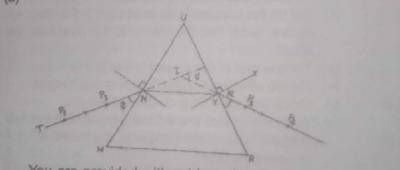
You are provided with a triangular glass prism, four optical pins, and other necessary materials.
n = \(\frac{sin (\frac{d_{m}+U}{2})}{sin{(\frac{u}{2})}}\)
(b)i. State the conditions necessary for total internal reflection of light to occur.
ii. The critical angle for a transparent substance is 39°. Calculate the refractive index of the substance.

You have been provided with a resistance box, a voltmeter, a key, a battery, and other necessary materials.
(b)i. Define the potential difference between two points in an electric circuit.
ii. Explain why the emf of a cell is greater than the p.d. across the call when it is supplying Current through an external resistance.


