


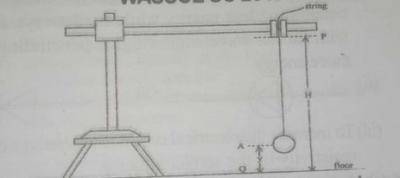
You are provided with a stopwatch, a meter rule, a split cork, retort stand and clamp, a pendulum bob, a piece of thread, and other necessary apparatus.
i. Place the retort stand on a laboratory stool. Clamp the split cork.
ii. Suspend the pendulum bob from the split cork such that the point of support P of the bob is at height H = 100cm above the floor Q. The bob should not touch the floor and H should be kept constant throughout the experiment.
iii. Adjust the length of the thread such that the center A of the bob is at a height y= AQ= 20cm from the floor.
iv. Displace the bob such that it oscillates in a horizontal plane.
v. Take the time t for 20 complete oscillations.
vi. Determine the period T of oscillation and evaluate T
vii. Repeat the procedure for four other values of y = 30cm, 40cm, 50cm, and 60cm. In each case, determine T and T.
viii. Tabulate the results.
ix. Plot a graph of T on the vertical axis and y on the horizontal axis, starting both axes from the origin (0,0).
x. Determine the slope, s, of the graph and the intercept c on the vertical axis.
xi. If in this experiment SR= c, calculate R.
x. State two precautions taken to ensure accurate results.
(b) i. The bob of a simple pendulum is displaced a small distance from the equilibrium position and then released to perform simple harmonic motion Identify where its:
(\(\propto\)) kinetic energy is maximum
(\(\beta\)) acceleration is maximum
ii. An object of weight 120N vibrates with a period of 4.0s when hung from a spring. Calculate the force per unit length of the spring. [g= 10ms\(^{-2}\), \(\pi\)=3.142]
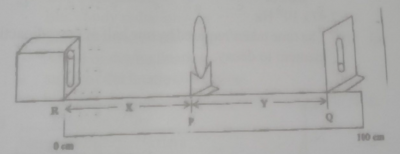
You are provided with a converging lens and holder, a screen, a ray box containing an illuminated object pin, and a meter rule.(See illustration above)
i. Place the lens in its holder such that it is facing a distant object seen through a well-lit laboratory window. Move the screen to and fro until a sharp image of the distant object is formed on it. Measure the distance, f\(_{0}\), between the screen and the lens.
ii. Clamp the meter rule securely to the table. Place the illuminated object pin at the end R of the meter rule.
iii. Place the lens at a position P such that X = RP = 20cm.
iv. Move the screen to a position Q to receive a sharp image of the object. Measure the distance Y = PQ.
v. Evaluate Z = (X+Y)
vi. Repeat the procedure for five other values of x = 25cm. 3Ocm, 35cm, 40cm and 45cm. In each case, record X,Y and evaluate Z.
vii. Tabulate the results.
viii. Plot a graph with Z on the vertical axis and X on the horizontal axis. Draw a smooth curve through the points.
ix. Determine from your graph the minimum value of Z=Z\(_{0}\) and its corresponding distance
x. Evaluate W = ½ (\(\frac{Z_0}{4} + \frac{X_0}{2}\))
xi. State two precautions taken to ensure accurate results.
(b) i. Draw a ray diagram to show how a Convex lens forms an image of magnification less than one.
ii. Name two pairs of features in the human eye and a lens camera that performs similar functions.

You are provided with a battery of e.m.f. E, a key K, a voltmeter, a standard resistor R\(_{0}\) = 2\(\Omega\), a resistance box R, and some connecting wires.
i. Measure and record the e.m.f. E of the battery.
i. Set up a circuit as shown in the diagram above with the key open.
iii. Set the resistance on the resistance box to R 22.
iv. Close the key, read and record the potential difference V on the voltmeter.
v. Evaluate V\(^{-1}\)
vi. Repeat the procedures for five other values of R = 5\(\Omega\) 10\(\Omega\),12\(\Omega\),15\(\Omega\) and 20\(\Omega\). In each case, record V and evaluate V\(^{-1}\)
vii. Tabulate the results.
viii. Plot a graph with R on the vertical axis and V\(^{-1}\) l on the horizontal axis, starting both axes from the origin (0,0).
ix. Determine the slope, s, of the graph and the intercept c on the vertical axis.
x. Calculate \(\propto\) and \(\beta\) from the equations s = R\(_{0}\) \(\propto\) and c= - (R\(_{0}\)+B).
xi. State two precautions taken to obtain accurate results.


You are provided with a pendulum bob, a metre rule, a stopwatch, a retort stand with clamp, and other necessary apparatus.
i. Suspend the pendulum bob from the clamp as illustrated in the diagram.
ii. Adjust the pendulum such that AC=L= 90 cm
iii. Displace the pendulum bob slightly such that it oscillates in a vertical plane.
iv. Measure and record the time t for 20 complete oscillations.
v. Evaluate T and \(\sqrt L\)
vi.Repeat the procedure for four others values of L= 80 cm,70 cm, 60 cm, and 50cm.
vii. Tabulate your readings
viii. Plot a graph with T on the vertical axis and \(\sqrt L\) on the horizontal axis.
ix. Determine the slope, s, of the graph.
x. Evaluate g= \(\frac{4\pi^{2}}{5^{2}}\)
xi. State two precautions taken to ensure accurate results.
(b) i. Determine from your graph, the period of the pendulum for L= 75 cm.
ii. A simple pendulum bob is set into simple harmonic motion. Sketch a diagram of the setup and indicate on it; the positions of:
(a) maximum velocity.
(b) maximum acceleration of the bob

You are provided with a metre rule, lens, screen, ray box, and other necessary apparatus.
i. Set up the experiment as shown in the diagram above. Measure and record the diameter a\(_{0}\), of the illuminated object.
ii. Place the object at a distance x= 25cm from the lens. Adjust the screen until a sharp image is obtained on the screen.
iii. Measure and record the diameter, a, of the image.
iv. Measure and record the distance v between the lens and the screen.
v. Evaluate y = P = \(\frac{1+y^{2}}{y}\) and T= x+v.
vi. Repeat the procedure for x = 30cm, 35cm, 40cm and 45cm. In each case, determine the corresponding values of a,v,y, P and T.
vii. Tabulate your results.
viii. Plot a graph of P on the vertical axis against T on the horizontal axis starting both axes from the origin (0,0).
ix. Determine the slope, s, of the graph.
x. Determine the intercept, c, on the horizontal axis.
xi Evaluate K = \(\frac{c}{2}\)
xii. State two precautions taken to ensure accurate results.
(b)i. Explain the statement, the focal length of a converging lens is 20cm.
ii. An object is placed at a distance x from a converging lens of focal length 20cm. If the magnification of the real image is 5, calculate the value of x.

