


(a) (i) What is a machine?
(ii) State two uses of gears.
(iii) Define the velocity ratio for a pair of gear wheels.
(iv) How can the mechanical advantage of a gear system be increased?
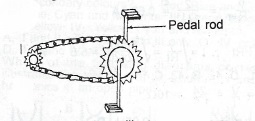
The diagram above illustrates the gears system of a bicycle.
(i) Determine its velocity ratio.
(ii) If the bicycle has an efficiency of 90%, calculate the effort required to overcome a load of 70N.
(iii) Why is the calculated effort less than the actual effort required?
(a) Explain the term critical angle.
(b) List two factors which determine the deviation of a ray of light by a triangular glass prism.
(c) The angle of refraction (r) of a ray of white light from air through a triangular glass prism of refractive index 1.5 is 29.0°. Calculate the angle through which the ray is least deviated.
(d) Study the ray diagram below and use it to answer the questions that follow.
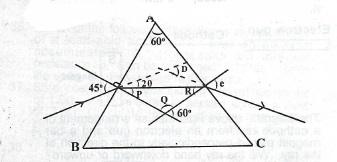
Calculate the:
(i) values of angles P,Q and R;
(ii) refractive index n of the glass prism;
(iii) value of e;
(iv) total deviation D.
(a) Define magnetic line of force.
(b) A wire of length 10 cm carrying a current of 4.0 A is placed between the poles of a powerful electromagnet of magnetic flux density 2.0 T. Calculate the:
(i) force on the wire when it is parallel to the field;
(ii) maximum force on the wire;
(iii) force on the wire when it makes an angle of 60° with the field.
(c) Describe how keepers can be used to preserve the magnetic strength of permanent bar magnets.
(d) A sailor observes that his mariners' compass reads N 10° W at a place where the angle of declination is N15° W. Calculate the true bearing of the place.


(a) (i) Explain why x-rays can be used to produce photographs of fractures in bones.
(ii) List four uses of x-rays other than in medicine.
(b) State the energy transformations which takes place during the operation of an x-ray tube.
(c) (i) Explain three named dangers to which human beings may be exposed when subjected to large doses of x-rays.
(ii) State two precautions that must be taken by persons working with x-rays.
(d) In an x-ray tube, an electron is accelerated from rest towards a tungsten target biased at a potential of 33 kV. Calculate, for the electron, the
(i) kinetic energy;
(ii) velocity. [h = 6.6 x 10\(^{-14}\) Js; Me = 9.1 x10\(^{-31}\) kg; c = 3.0 x 10\(^4\) ms\(^{-1}\); e = 1.6 x 10\(^{-19}\) C.]
A spiral spring with a metal extends by 10.5 cm in air. When the metal is fully submerged in water, the spring extends by 6.8 cm. Calculate the relative density of the metal. (Assume Hooke's law is obeyed)
