


A black body radiates maximum energy when its surface temperature T and the corresponding wavelength \(\lambda\)max are related by the equation \(\lambda\)max T = constant. Given the values of the constant and surface temperature as 2.9 x 10\(^{-3}\) mK and 57°C respectively; Calculate the frequency of the energy radiated.
(a) Define uniform acceleration.
(b) Forces act on a car in motion. List the
(i) horizontal forces and their directions;
(ii) vertical forces and their directions
(c) A car starts from rest and accelerates uniformly for 20s to attain a speed of 25 ms\(^{-1}\). It maintains this speed for 30s before decelerating uniformly to rest. The total time for the journey is 60 seconds.
(i) Sketch a velocity-time graph for the motion.
(ii) Use the graph to determine the (\(\alpha\)) total distance travelled by the car (\(\beta\)) deceleration of the car.
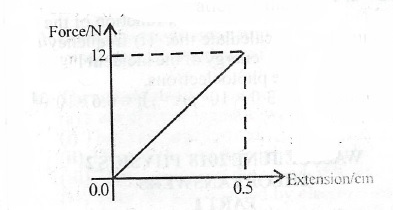
The figure above illustrates a force-extension graph for a stretched spiral spring. Determine the work done on the spring. SEE THE DIAGRAM ABOVE

(a) List two factors each that affect heat loss by:
(i) radiation;
(ii) convection.
(b) State two factors that determine the quantity of heat in a body.
(c) Explain the statement: The vecilic latent heat of vaporization of mercury is 2.72 x 10\(^5\) Jkg\(^{-1}\).
(d)A jug of heat capacity 250 Jkg\(^{-1}\) contains water at 28°C. An electric heater of resistance 35\(\Omega\) connected to a 220 V source is used to raise the temperature of the water until it boils at 100°C in 4 minutes. After. another 5 minutes, 300 g of water has evaporated. Assuming no heat is lost to the surroundings, calculate the:
(i) mass of water in the jug before heating;
(ii) specific latent heat of vaporization of steam. [Specific heat capacity of water = 4200 kg\(^{-1}\)K\(^{-1}\)]
(a) Define dffraction.
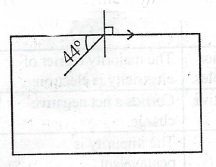
(b)(i) Explain critical angle. The diagram here illustrates a ray of light passing through a rectangular transparent plastic block \(\alpha\) Determine the value of the critical angle. \(\beta\) Calculate the refractive index of the block.
(c) A pipe closed at one end has fundamental frequency of 200Hz. The frequency of the first overtone of the closed pipe is equal to the frequency of the first overtone of an open pipe. Calculate the:
(i) fundamental frequency of the open pipe;
(ii) length of the closed pipe;
(iii) length of the open pipe. [Speed of sound in air = 330 ms\(^{-1}\)]

