Your School's Whatsapp Group - Join Us now
WAEC and NECO CBT App for Mobile Devices - Candidates, Schools, Centres, Resellers - 100% Offline -Download Now

Physics WAEC Past Questions

Clear Selections
Change Subject Post a Question Check Syllabus Study My Bookmarks Past Questions Videos Watch Video Lessons Download App

Your School's Whatsapp Group - Join Us now
WAEC and NECO CBT App for Mobile Devices - Candidates, Schools, Centres, Resellers - 100% Offline -Download Now
Post UTME Past Questions Agent
661

A wave has an amplitude equal to 4.0m, angular speed \(\frac{1}{3} \pi\) rads-1 and phase angle \(\frac{2}{3} \pi\) rad. The displacement y of the wave particle is given as
  • A. y = 4 sin \(\frac{\pi}{3}\)(t + 2)
  • B. y = 4 sin \(\frac{\pi}{3}\)(t + \(\frac{2}{\pi}\)
  • C. y = 4 sin \(\frac{\pi}{3} (2t + 1)\)
  • D. y = 4 sin \(\frac{\pi}{3}\) (t + 1)
View Answer & Discuss (10) WAEC 2000
662

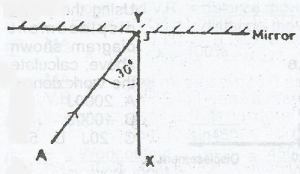
In the diagram above, an incident ray AY makes an angle of 30o with the normal XY. If the mirror is rotated anticlockwise about Y through an angle of 20o, while AY is fixed, what angle will the reflected ray now make with the incident ray?

  • A. 70o
  • B. 80o
  • C. 100o
  • D. 120o
View Answer & Discuss (4) WAEC 2000
663

A concave mirror can be used to produce a parallel beam of light if a lighted bulb is placed

  • A. between its focus and the pole
  • B. at its focus
  • C. at its centre of curveture
  • D. between its focus and centre of curvature
View Answer & Discuss (4) WAEC 2000
WAEC and NECO CBT Software for Computers and Laptops - Candidates, Schools, Centres, Resellers - 100% Offline -Download Now
Post UTME Past Questions Agent
Post-UTME Past Questions - Original materials are available here - Download PDF for your school of choice + 1 year SMS alerts
664

A simple microscope forms an image 10cm from an eye close to the lens. If the object is 6cm from the eye, calculate the focal length of the lens

  • A. 3.75cm
  • B. 4.00cm
  • C. 15.00cm
  • D. 16.00cm
View Answer & Discuss (6) WAEC 2000
665

When white light passes through a triangular glass prism, there is dispersion because of

  • A. diffraction of light
  • B. polarisation of light
  • C. the difference in speed of the components of light
  • D. the interference of light waves in glass
View Answer & Discuss WAEC 2000
Start a Free Practice Test
 
WAEC and NECO CBT Software for Computers and Laptops - Candidates, Schools, Centres, Resellers - 100% Offline -Download Now
Post-UTME Past Questions - Original materials are available here - Download PDF for your school of choice + 1 year SMS alerts
WAEC and NECO CBT App for Mobile Devices - Candidates, Schools, Centres, Resellers - 100% Offline -Download Now
Your School's Whatsapp Group - Join Us now