Post-UTME Past Questions - Original materials are available here - Download PDF for your school of choice + 1 year SMS alerts
Post UTME Past Questions Agent

Physics Past Questions

Clear Selections
Change Subject Post a Question Check Syllabus Study My Bookmarks Past Questions Videos Watch Video Lessons Download App

Your School's Whatsapp Group - Join Us now
WAEC and NECO CBT App for Mobile Devices - Candidates, Schools, Centres, Resellers - 100% Offline -Download Now
Post-UTME Past Questions - Original materials are available here - Download PDF for your school of choice + 1 year SMS alerts
4441

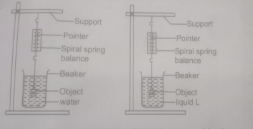
Study the diagrams above and use them as guides in carrying out the following instructions.

  1. Using the spring balance provided, determine the weight of the object of mass M= 50.0g in air. Record this weight as W\(_{1}\).
  2. Determine the weight of the object when it is completely immersed in water contained in a beaker as shown in the diagram above. Record the weight as W\(_{2}\).
  3. Determine the weight of the object when it is completely immersed in a liquid labeled L. Record the weight as W\(_{3}\).
  4. Evaluate U = (W\(_{1}\) - W\(_{2}\)) and V = (W\(_{1}\) -W\(_{3}\)).
  5. Repeat the procedure with the objects of masses M= 100g, 150g, 200g, and 250g
  6. In each case, evaluate U = (W\(_{1}\) - W\(_{2}\)) and V = (W\(_{1}\) -W\(_{3}\)).
  7.  Tabulate your readings.
  8. Plot a graph with V on the vertical axis and U on the horizontal axis.
  9. Determine the slope, s, of the horizontal graph.
  10. State two precautions taken to ensure accurate results.

(b)i. State Archimedes' principle.

ii.  A piece of brass of mass 20.0g is hung on a spring balance from a rigid support and completely immersed in kerosene from of density 8.0 x 10\(^{2}\)kgm\(^{-3}\).  Determine the readings of the spring balance (g= 10ms\(^{-2}\), density of brass 8.0 x 10\(^{3}\)kgm\(^{-3}\))

View Answer & Discuss (1) WAEC 2012
4442

Open Photo

You are provided with a syringe, a petri-dish firmly attached to the base of the movable piston (plunger) of the syringe, a Set of weights, and other necessary apparatus.

  1. Pull the piston of the syringe upward until it can no longer move. Read and record this position of the piston on the graduated mark on the syringe as V\(_{o}\).
  2. Clamp the syringe and ensure that it is vertical.
  3. Place a mass M= 500g gently at the center of the petri-dish.
  4. Read and record the new position of the piston as V.
  5. Evaluate V\(^{1}\).
  6. Repeat the procedure for four other values of M= 1000g, 1500g, 2000g, and 2500g.
  7. Tabulate your readings.
  8. Plot a graph with V\(^{-1}\) on the vertical axis and M on the horizontal axis, starting both axes from the origin (0,0).
  9. Determine the slope, s, of the graph.
  10. Evaluate k = s\(^{-1}\).
  11. State two precautions taken to ensure accurate results.

(b)i. When a weight is placed on the petri-dish, which quantities of the gas in the syringe (\(\Omega\)) increases; (\(\beta\)) decrease?

ii. What is responsible for the pressure exerted by a gas in a closed vessel?


View Answer & Discuss WAEC 2012
4443

Open Photo


You are provided with a potentiometer, an ammeter, a voltmeter, a standard resistor, and other necessary apparatus. Using the circuit diagram above as a guide carry out the following instructions.

  1. Set up a circuit as illustrated in the diagram above.
  2. Close the key, K.
  3. Read and record the ammeter reading l\(_{o}\) and the voltmeter reading V\(_{o}\) when jockey J is not making contact with the potentiometer wire OQ.
  4. Using J, make a contact with the potentiometer wire OQ at a point P such that OP = 1Ocm.
  5. Read and record the current and the corresponding value of the voltage V.
  6. Repeat the procedure for other values of OP= 20cm, 30cm, 40cm, 50cm, and 60cm.
  7. Tabulate your readings.
  8. Plot a graph with V on the vertical axis and I on the horizontal axis, starting both axes from the origin (0, 0).
  9. Determine the slope, s, of the graph.
  10. Determine the value of V when = 0.
  11. State two precautions taken to obtain accurate results.

(b) i. State two advantages of a lead-acid accumulator over a dry Leclanche cell.

ii. A cell of emf 2V and internal resistance of 1\(\Omega\) passes current through an external load of 9\(\Omega\). Calculate the potential drop across the cell.

View Answer & Discuss WAEC 2012
Post UTME Past Questions Agent
WAEC and NECO CBT Software for Computers and Laptops - Candidates, Schools, Centres, Resellers - 100% Offline -Download Now
Post-UTME Past Questions - Original materials are available here - Download PDF for your school of choice + 1 year SMS alerts
4444

Open Photo

You are provided with a wooden block to which a hook is fixed, a set of masses, spring balance, and other necessary materials. Using the diagram above as a guide, carry out the following instructions.

  1. Record the mass m\(_{0}\), indicated on the wooden block.
  2. Place the block on the table.
  3. Attach the spring balance to the hook.
  4. Pull the spring balance horizontally with a gradual increase in force until the block just starts to move Record the spring balance reading F.
  5. Repeat the procedure by placing in turn mass m=200, 400, 600, and 800g on top of the block. In each case, read and record the corresponding value of F.
  6. Evaluate M = m\(_{0}\) + m and R = \(\frac{m}{100}\) in each case
  7. Tabulate your readings.
  8. Plot a graph with F on the vertical axis and R on the horizontal axis
  9. Determine the slope, s, of the graph.
  10. State two precautions taken to ensure accurate results.

(b)i. Define coefficient of static friction. 

ii. A block of wood of mass 0.5 kg is pulled horizontally on a table by a force of 2.5 N. Calculate the coefficient of static friction between the two surfaces.(g = 10ms\(^{-2}\))
View Answer & Discuss WAEC 2011
4445

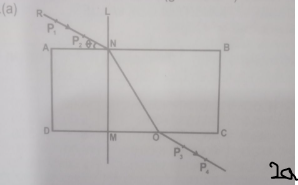
Use the diagram above as a guide to carry out the following experiment.

  1. Trace the outline ABCD of the rectangular glass prism on the drawing paper provided.
  2. Remove the prism. Select a point N on AB such that AN is about one-quarter of AB.
  3. Draw the normal LNM. Also, draw a line RN to make an angle \(\theta\) = 75° with AB at N.
  4. Fix two pins at P\(_{1}\) and P\(_{2}\) on line RN. Replace the prism on its outline.
  5. Fix two other pins at P\(_{3}\) and P\(_{4}\) such that they appear to be in a straight line with the images of the pins at P\(_{1}\) and P\(_{2}\) when viewed through the prism from DC.
  6. (vi) Remove the prism and the pins at P\(_{3}\) and P\(_{4}\). Draw a line to join P\(_{3}\) and P\(_{4}\) 
  7. Produce line P\(_{4}\) P\(_{3}\) to meet the line DC at O. Draw a line to join NO.
  8. Measure and record the values of MO and NO.
  9. Evaluate \(\theta\) = \(\frac{MO}{NO}\) and cos \(\theta\).
  10. Repeat the procedure for four other values of \(\theta\) = 65° 55°, 45°, and 35°. In each case, evaluate \(\theta\) and cos \(\theta\).
  11. Tabulate your readings.
  12. Plot a graph with cos \(\theta\) on the vertical axis and \(\theta\) on the horizontal axis.
  13. Determine the slope, s, of the graph.
  14. State two precautions taken to ensure accurate results

(b)i. State Snell's law of refraction.

ii. Calculate the critical angle for the glass prism used in the experiment above if its refractive index is 1.5.

View Answer & Discuss (7) WAEC 2011
Start a Free Practice Test
 
WAEC and NECO CBT App for Mobile Devices - Candidates, Schools, Centres, Resellers - 100% Offline -Download Now
Post UTME Past Questions Agent
Post-UTME Past Questions - Original materials are available here - Download PDF for your school of choice + 1 year SMS alerts
WAEC and NECO CBT Software for Computers and Laptops - Candidates, Schools, Centres, Resellers - 100% Offline -Download Now