WAEC and NECO CBT Software for Computers and Laptops - Candidates, Schools, Centres, Resellers - 100% Offline -Download Now
Post-UTME Past Questions - Original materials are available here - Download PDF for your school of choice + 1 year SMS alerts

Physics Past Questions

Clear Selections
Change Subject Post a Question Check Syllabus Study My Bookmarks Past Questions Videos Watch Video Lessons Download App

Post UTME Past Questions Agent
WAEC and NECO CBT App for Mobile Devices - Candidates, Schools, Centres, Resellers - 100% Offline -Download Now
Post-UTME Past Questions - Original materials are available here - Download PDF for your school of choice + 1 year SMS alerts
4436

Open Photo

You are provided with an illuminated object, converging lens, screen, metre rule, and other necessary materials.

  • Measure and record the size a\(_{o}\) of the illuminated object.
  • Place the object O and the screen S on Opposite sides of the converging lens L.
  • Set the distance between the object and the lens U = 30cm.
  • Adjust the screen until a sharp image of the illuminated object is obtained on the screen.
  •  Measure and record the size a of the image.
  • Evaluate m = \(\frac{a}{a_{0}}\), and m\(^{-1}\)
  • Repeat the procedure for four other values of U=35cm, 40cm, 45cm and 50cm respectively.
  • Tabulate your readings.
  • Plot a graph with m\(^{-1}\) on the vertical axis and U on the horizontal axis.
  • Determine the slope, s, of the graph and intercept, C, on the vertical axis.
  • Determine the value of U for which m\(^{-1}\)=0.
  • State two precautions taken to obtain accurate results.

(b)i. Using your graph, determine the value of m for which U= 37cm.

ii. Sketch a diagram to illustrate how a converging lens may be used to produce a real diminished image of an object.
View Answer & Discuss WAEC 2014
4437

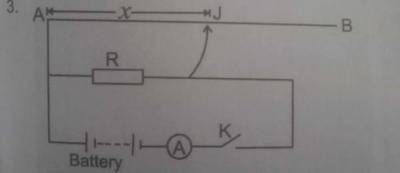
You are provided with a potentiometer AB, a 102\(\Omega\) standard resistor R, a battery of emf 4.5V, a jockey J, and other necessary materials.

  1. Connect a circuit as shown in the diagram above.
  2. Close key K. Without J making contact with AB, read and record the ammeter reading I. Open the key.
  3. Use the jockey to make contact with AB at the 20cm mark such that AJ = x = 20cm. Close the key, read and record the ammeter reading.
  4.  Evaluate x\(^{-1}\).
  5. Repeat the procedure for values of x= 35cm, 45cm, 60cm, and 80cm respectively.
  6. Tabulate your readings.
  7. Plot a graph with x\(^{-1}\) on the vertical axis and l\(_{i}\) on the horizontal axis, starting both axes from the origin (0, 0).
  8. Determine the slope, s, of the graph.
  9. From your graph, determine the value l\(_{o}\) of I\(_{1}\) for which x\(^{-1}\)= 0.
  10. Evaluate \(\frac{I_{o}}{I}\).
  11. State two precautions taken to obtain accurate results.

(b)i. Define the emf of a battery.

ii. A cell X of emf 1.018V is balanced by a length of 50.0cm on a potentiometer wire. Another cell Y is balanced by a length of 75.0cm on the same wire. Calculate the emf of Y.

View Answer & Discuss (2) WAEC 2014
4438

You are provided with a uniform metre rule of mass, M indicated on its reverse side, a knife-edge, a graduated measuring cylinder of known mass, M\(_{1}\) marked on it and other necessary apparatus.

  1. Read and record with values of M and m\(_{1}\). 
  2. Balance the metre rule horizontally on the knife edge. Read and record the balance point as G.
  3. Tie a loop of thread around the neck of the measuring cylinder.
  4. Fill the cylinder with the sand provided to the 2cm\(^{3}\) mark. Record the volume, V, of the sand.
  5. Hang the cylinder at the 2 cm mark of the metre rule and adjust the position of the knife edge until the rule balances horizontally.
  6. Read and record the new balance position K.
  7. Determine the value of e and f.
  8. Determine the mass, m\(_{2}\), of the sand in the measuring cylinder. Hint: m\(_{2}\) = (\(\frac{\text {M x f}}{e}\)) - m\(_{1}\).
  9. Repeat the procedure by filling the measuring cylinder to the mark V = 4,6,8 and 10 cm\(^{3}\). In each case, ensure that the measuring cylinder is kept constant at the 2 cm mark on the metre rule.
  10. Tabulate your readings.
  11. Plot a graph with m\(_{2}\) on the vertical axis and V on the horizontal axis.
  12. Determine the slope, s, of the graph.
  13. State two precautions taken to ensure accurate results.

(b)i. Determine the mass of 7.5 cm\(^{3}\) of the sand using your graph.

ii. A gold coin of mass 102.0 g has a uniform cross-sectional area of 10.0 cm\(^{2}\). Calculate its thickness. [Density of gold=19.3 g cm\(^{-3}\)]

View Answer & Discuss WAEC 2013
Post UTME Past Questions Agent
WAEC and NECO CBT Software for Computers and Laptops - Candidates, Schools, Centres, Resellers - 100% Offline -Download Now
Your School's Whatsapp Group - Join Us now
4439

Open Photo

Using the diagram above as a guide, carry out the following instructions:

  1. Fix a plain sheet of paper on the Celotex board.
  2. Place the rectangular glass prism on the paper and trace its outline, ABCD. Remove the prism.
  3. Draw a normal NMP to meet AB and DC at M and P respectively such that |AM|=DP=2.0cm.
  4. Trace the ray PQ with two pins, P\(_{1}\) and P\(_{2}\) at P and Q respectively such that angle MPQ = =50º 
  5. Replace the prism on its outline. Trace the emergent ray with two other pins P\(_{3}\) and P\(_{4}\) such that they lie in a straight line with P\(_{2}\) and the image of P\(_{1}\) viewed through the glass prism.
  6. Measure and record \(\theta\), the angle between the emergent ray and face AB of the glass prism.
  7. Evaluate cos \(\theta\) and sin i.
  8. Repeat the procedure for four other values of = 10°, 15°,20° and25°.
  9. Tabulate your readings.
  10. Plot a graph with cos \(\theta\) on the vertical axis and sin i on the horizontal axis.
  11. Determine the slope, s, of the graph
  12. State two precautions taken to ensure accurate results. Attach your traces to your answer booklet 

(b)i. State the laws of refraction of light

ii. Explain what is meant by the statement the refractive index of a material is 1.65

View Answer & Discuss WAEC 2013
4440

Open Photo

You are provided with a constantan wire, a2 \(\Omega\)standard resistor, an accumulator E, an ammeter A, a key K, and other necessary apparatus.

  1. Measure and record the emf of the accumulator provided
  2. Connect a circuit as shown in the diagram above.
  3. Close the key, read and record the ammeter reading l\(_{o}\) when the crocodile clip is not in contact with the Constantan wire.
  4. Open the key with the clip making contact with the wire, when d=90cm, close the key. Read and record the ammeter reading l.
  5. Evaluate d\(^{_1}\)
  6. Repeat the procedure for four other values of d=80, 70, 60, and 50 cm
  7. In each case, read and record the ammeter reading and evaluatre d\(^{_1}\).
  8. Tabulate your readings.
  9. Plot a graph with I on the vertical axis and d\(^{_1}\) on the horizontal aXIS.
  10. Determine the slope, S of the graph and its intercept, c, on the vertical axis.
  11. Evaluate k = \(\frac{c}{s}\)
  12. Using your graph, determine the current I when d=55cm.
  13. State two precautions taken to obtain accurate results.

(b)i. Explain what is meant by the potential difference between two points in an electric circuit.

ii.  State two factors on which the resistance of a wire depends.

View Answer & Discuss WAEC 2013
Start a Free Practice Test
 
Post UTME Past Questions Agent
Post-UTME Past Questions - Original materials are available here - Download PDF for your school of choice + 1 year SMS alerts
WAEC and NECO CBT App for Mobile Devices - Candidates, Schools, Centres, Resellers - 100% Offline -Download Now
WAEC and NECO CBT Software for Computers and Laptops - Candidates, Schools, Centres, Resellers - 100% Offline -Download Now
