


(a) The mass and wavelength of a moving electron are 9.0 x 10\(^{-31}\) kg and 1.0 x 10\(^{-10}\)m respectively. Calculate the kinetic energy of the electron. [ h = 6.6 x 10\(^{-34}\) Js]
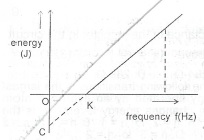
The above reprt the graph electron energy against the frequency of the radiation incident on a metal surface. lnterprete the;
(i) slope of the graph;
(ii) intercept, OC;
(iii) intercept, OK.
(a) Distinguish between stress and strain as used in elasticity.
(b) When a force of 40 N is applied to the free end of an elastic cord, an extension of 5cm is produced in the cord. Calculate the work done on the cord.

(a) In his first attempt, a long jumper took off from the springboard with a speed of 8 ms\(^{-1}\) at 30° to the horizontal. He makes a second attempt with the same speed at 45° to the horizontal. Given that the expression for the horizontal range of a projectile is \(\frac{v^2 sin \theta}{g}\) where all the symbols have their usual meanings, show that he gains a distance of 0.8576 m in his second attempt.
(b)(i) State Hooke's law of elasticity.
(ii) Describe an experiment to verify Hooke's law.
(iii) State two precautions you would take if you were to perform this experiment in the laboratory.
(c) A spiral spring of natural length 20.00 cm has a scale pan hanging freely in its lower end. When an object of mass 40 g is placed in the pan, its length becomes 21.80 cm. When another object of mass 60g Is placed in the pan, the length becomes 22.05cm. Calculate the mass of the scale pan. [g = 10 ms\(^{-2}\)]
(a) Define specific heat capacity.
(b)(i) With the aid of a labelled diagram, describe an experiment to determine the specific heat capacity of copper using a copper ball.
(ii) State two precautions necessary to obtain accurate results.
(c) A piece of copper block of mass 24 g at 230°C is placed in a copper calorimeter of mass 60 g containing 54 g of water at 31°C. Assuming heat losses are negligible, calculate the final steady temperature of the mixture. [specific heat capacity of water = 4200 J kg\(^{-1}\) K\(^{-1}\)] [specific heat capacity of copper = 400 J kg\(^{-1}\) K\(^{-1}\)]

