


(a) Define ionization potential.
(b)(i) State the three types of emission spectra.
(ii) Name one source each which produces each of the spectra stated in (b)(i).
(c) In an x-ray tube, electrons are accelerated the target by a potential difference of 80 A Calculate the:
(i) speed of the electron;
ii) threshold wavelength of the electron. [h=6.6 x 10\(^{-34}\) Js; e = 1.6 x 10\(^{-19}\) C; Me = 9.1 x 10\(^{-31}\)
d) An x-ray photon of frequency 4.5 x 10\(^{-18}\) strikes an. electron, assumed to be at rest. If t electron absorbs all the photon energy, calculate the speed acquired by the electron. [ h = 6.6 x 10\(^{-34}\) Js; Me = 9.1 x 10\(^{-31}\) kg ]
(a) Define boiling point of a liquid.
(b) Describe how water in a round bottom flask could be made to boil without heating it. [diagram not necessary]
(c) State three applications of expansion of metals.
(d) A room with floor measurements 7m x 10 m contains air of mass 250 kg at a temperature of 34°C. The air is cooled until the temperature falls to 24°C. Calculate the: (i) height of the room;
(ii) quantity of energy extracted to cool the room;
(iii) which is higher: the calculated value or the actual energy needed to cool the room? Give a reason for your answer. [ Specific heat capacity of air = 1010 Jkg\(^{-1}\)K\(^{-1}\); density of air = 1.25 kg m\(^{-3}]

Name the three basic components P, Q and R that make up a cathode ray tube, as illustrated in the diagram above

A ray of light is incident on an air-glass boundary at an angle \(\theta\). If the angle between the partially reflected ray and the refracted ray is 90°, calculate \(\theta\), given that the refractive index of glass is 1.50.
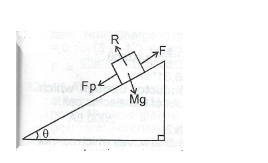
In the diagram illustrated, a body of mass m slides on an inclined plane. Show that the coefficient M\(_g\) of friction between the surfaces in contact is tan \(\theta\).

