


(a) Explain how a gas can be made to conduct electricity.
(b) Name the electric charge carriers in gases.
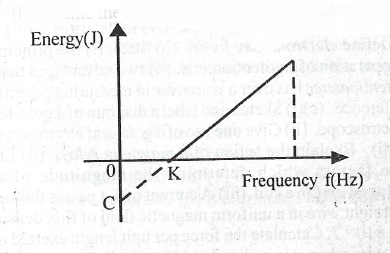
The diagram above represents the graph of electron energy against the frequency of the radiation incident on a metal surface. Interpret the: (a) slope of the graph; (b) intercept, OC; (c) intercept, OK.
(a) State two conditions under which photo-electrons can be emitted from the surface of a metal.
(b) List two particle characteristics of electromagnetic waves.

(a) Give two examples each of:
(i) rotational motion;
(ii) linear motion.
(b) Describe a laboratory experiment to determine the density of an irregularly shaped solid.
(c) State Newton's second law of motion
(d) Explain the term inertia.
(e)
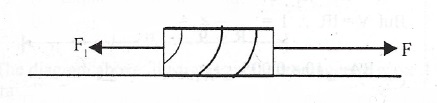
The diagram above illustrates a body of mass 5.0 kg being pulled by a horizontal force F. If the body accelerates at 2.0 ms\(^{-2}\) and experiences a frictional force of 5 N, calculate the:
(i) net force on it;
(ii) magnitude of F;
(iii) coefficient of kinetic friction. [ g = 10 ms\(^{-2}\)]
a) Define heat capacity and state its unit.
(b) List two effects of heat on a substance.
(c) Explain how a tightly fitted glass stopper could be removed from a reagent bottle.
(d) A quantity of pepper soup of mass 800 g poured into a plastic container with a tight-fitting lid has a temperature of 30°C. The container is then placed in a microwave oven, rated 1200 W and operated for 3 minutes.
(i) Calculate the final temperature attained by the soup. (Assuming no heat losses).
(ii) Explain why containers with tight-fitting lids are not suitable for use in microwave cooking.
(iii) When the soup is brought out and allowed to cool, a dent is observed on the container. Explain. [Take specific heat capacity of the soup = 4000 Jkg\(^{-1}\) K\(^{-1}\)]

