


2a. State Faraday's law of electromagnetic induction.
b. Draw a labelled diagram of an induction coil and explain how it works.
c. How is the effect of eddy currents minimized in the coil?
d. State two reasons why a capacitor should be included in the primary circuit of the coil.
e. State three uses of an induction coil.
3a. What is surface tension? Explain the phenomenon in terms of intermolecular forces.
b. Describe a simple experiment to demonstrate the surface tension of a liquid.
c. State three examples to illustrate the effects of surface tension.
d. Why does water wet a clean glass surface, whereas mercury does not?
e. State two methods by which the surface tension of a liquid may be reduced.
4a. Define the boiling point of a liquid.
b. Describe with the aid of a labelled diagram, an experiment to determine the boiling point of a small quantity of a liquid.
c. State two factors that may affect the boiling point of a liquid.
d. Using the kinetic theory of matter, explain why pure water changes to steam at S.T.P without any change in temperature, although heat is being supplied to the water.


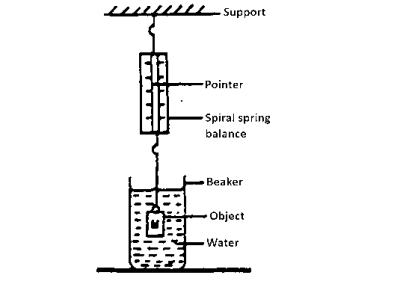
1a. (i) Using the spring balance provided, determine the weight of an object of mass M = 5.0 g. Record this weight as W\(_1\).
(ii) Determine the weight of the object when completely immersed in water contained in a beaker as shown in the diagram. Record the weight as W\(_2\).
(iii) Determine the weight of the object when it is completely immersed in the liquid labelled "L". Record the weight as W\(_3\). Evaluate u = (W\(_1\) - W\(_2\)) and v = (W\(_1\) - W\(_3\)).
(iv) Repeat the procedure with the objects of masses M = 10, 15, 20, and 25 g. In each case, evaluate v = (W\(_1\) - W\(_3\)) on the vertical axis against u = (W\(_1\) - W\(_2\)) on the horizontal axis.
(v) Determine the slope, s, of the graph.
(vi) State two precautions taken to ensure accurate results.[21 marks]
bi. A piece of brass of mass 20.0 g is hung on a spring balance from a rigid support and completely immersed in kerosene of density 8.0 × 10\(^2\) kgm\(^{-3}\). Determine the reading on the spring balance. [g = 10 ms\(^{-2}\), density of brass = 8.0 × 10\(^3\) kgm\(^{-3}\)]
(Provide your answer with unit e.g 123.123 m)
bii. Archimedes' Principle and Law of Floatation [2 marks]
2a.
(i) Fix a metre rule on the bench with the graduated face up.
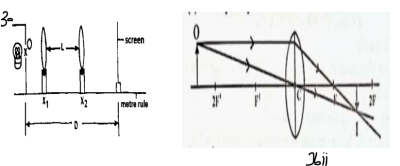
(ii) Place the illuminated object at the zero end of the rule and the screen at the other end as illustrated in the diagram above.
(iii) Measure and record D, the distance between the object and the screen. Evaluate D\(^2\)
(iv) Place and move the converging lens between the illuminated object and the screen until a diminished, sharp image of the object is formed on the screen. Read and record the position, x\(_1\), of the lens. From this position, move the lens towards the object until another sharp image of the object is formed on the screen. Read and record the position, x\(_2\), of the lens.
(v) Evaluate and record L = (x\(_1\) - x\(_2\)), L\(^2\) and (D\(^2\) - L\(^2\)).
(vi) Repeat the procedure for D = 90, 80, 70, and 60 cm. In each case, evaluate L, L\(^2\), and (D\(^2\) - L\(^2\)). Tabulate your readings.
(vii) Plot a graph of D\(^2\) - L\(^2\) on the vertical axis against D on the horizontal axis.
(viii) Determine the slope, s, of the graph and evaluate K = \(\frac{\text{s}}{4}\). State two precautions taken to ensure accurate results.[21 marks]
bi. Distinction Between Real and Virtual Images [2 marks]
ii. Draw a ray diagram to show how a converging lens may be used to form a real diminished image of an object [2 marks]
