


(a) (i) Explain (I) electric potential; (II) electric potential energy
(ii) State the SI unit of each of the term in (a)(i) above
(b) An isolated electrically charged sphere of radius, r, and charge, Q, is supported on an insulator in air of permitivity, \(\varepsilon_o\). Write down;
(i) an expression for the electric field intensity on the surface of the sphere;
(ii) an expression for the electric potential at the surface of the sphere;
(iii) a relationship between the electric field intensity and the electric potential at the surface of the sphere
(c) The plates of a parallel plate capacitor, 5.0 x 10\(^{-3}\) m apart are maintained at a potential difference of 5.0 x 10\(^{4}\) V. Calculate the magnitude f the
(i) electric field intensity between the plates
(ii) force on the electron
(iii) acceleration of the elctron
[electronic charge = 1.60 x 10\(^{-19}\)C, mass of electron = 9.1 \times 10\(^{-31}\) kg]
(a) State two;
(i) differences between nuclear fusion and nuclear fission;
(ii) peaceful uses of atomic energy
(b)(i) Explain chain reaction
(ii) State (I) one condition necessary for chain reaction to occur.
(II) two components in a nuclear reactor used to control chain reaction.
(c)(i) A nuclear reaction is given \(^2_1H + ^3_1H = ^4_0n\) + energy
What type of nuclear reaction is it?
(ii) The isotope of a nuclide has a half life of 5.40 x 10\(^3\) s, Calculate its decay constant.


In his first attempt, a long jumper took off from the spring board with a speed of 8 ms\(^{-1}\) at 30° to the horizontal. He makes a second attempt with the same speed at 45° to the horizontal. Given that the expression for the horizontal range of a projectile is \(\frac{u^2 sin 2\theta}{g}\) where all the symbols have their usual meanings, show that he gains a distance of 0.8576 m in his second attempt. [g = 10ms\(^{-2}\)]
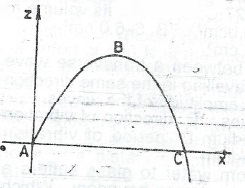
The diagram above illustrates the path ABC, in a vertical x z plane, of a bullet shot into the air at an angle above the horizontal. Copy the diagram, and, using arrows, indicate the relative magnitudes and directions of the vertical and horizontal components of the velocities of the bullet at the point A, B and C.
