Post-UTME Past Questions - Original materials are available here - Download PDF for your school of choice + 1 year SMS alerts
WAEC and NECO CBT Software for Computers and Laptops - Candidates, Schools, Centres, Resellers - 100% Offline -Download Now

Physics Past Questions

Clear Selections
Change Subject Post a Question Check Syllabus Study My Bookmarks Past Questions Videos Watch Video Lessons Download App

Your School's Whatsapp Group - Join Us now
Post UTME Past Questions Agent
WAEC and NECO CBT Software for Computers and Laptops - Candidates, Schools, Centres, Resellers - 100% Offline -Download Now
4431

Open Photo

You are provided with a variable d.c. power supply E, a 2\(\propto\) standard resistor, a key, an ammeter, a voltmeter and other necessary materials.

i. Set up a circuit as shown in the diagram above with E= 1.5V

ii. Close the key k.

iii. Take and record the voltmeter reading V.

iv. Take and record the corresponding ammeter reading l.

v. Evaluate V\(^{-1}\) and l\(^{-1}\)  

vi. Repeat the procedure for four other values of E= 3.0V, 4.5V, 6.0V, and 7.4V.

vii. Tabulate your readings.

viii. Plot a graph with V\(^{-1}\)  on the vertical axis and l\(^{-1}\) on the horizontal axis starting both axes from the origin (0, 0).

ix. Determine the slope, s, of the graph.

x. Also determine the intercept, e, on the vertical axis.

xi. State two precautions taken to obtain accurate results.

(b)i. State two methods by which an electric current can be produced.

ii
Open Photo

Calculate the value of R in the circuit diagram shown above, given that the effective resistance of the circuit is 4.0\(\Omega\) and the internal resistance of the cell is negligible.

View Answer & Discuss (1) WAEC 2016
4432

Open Photo

You are provided with a retort stand, boss head, clamp, stopwatch, slotted weights, hanger, grooved pulley, thread, measuring tape, and other necessary materials.

i. Measure and record the radius R of the pulley.

ii. Setup the apparatus as illustrated in the diagram above, such that the clamp is 1.5 m above the floor.

iii. Tie one end of the thread to the pulley.

iv. Tie the other end of the thread to the hanger.

v. Slot a mass m= 50 g on the hanger.

vi. Wind the thread around the groove of the pulley until the base of the hanger is at a height = 1.4 m above the floor. Maintain this height h for every other value of m through out the experiment.

vii. Release the mass to unwind the thread.

viii. Determine and record the time t taken by the mass m to reach the floor.

ix. Evaluate t\(^{2}\)

x.  Also evaluate
a =\(\frac{2h}{t^{2}}\),T = \(\frac{m}{1000}\) (10 - a) and \(\propto\) = \(\frac{a}{R}\)

xi. Repeat the procedure for four other values of m = 70 g, 90 g, 110 g and 130 g

xii. Tabulate your readings.

xiii. Plot a graph with \(\propto\) on the vertical axis and T on the horizontal axis.

xiv. Determine the slope s, of the graph.

xv. Evaluate  I = \(\frac{R}{s}\).

xvi. State two precautions taken to obtain accurate results.

(b)i. Define centripetal force

ii. An object drops to the ground from a height of 2.0 m. Calculate the speed with which it strikes the ground. [g=10 ms\(^{-2}\)]
View Answer & Discuss WAEC 2015
4433

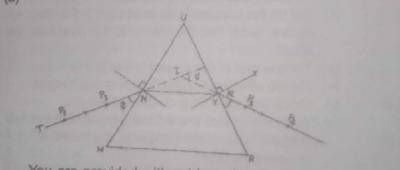
You are provided with a triangular glass prism, four optical pins, and other necessary materials.

  • Place the triangular glass prism on a drawing paper and draw its outline UMR. Remove the prism.
  • Measure and record the value of the angle at U.
  • Draw a normal to the line UM at N. Also, draw another line TN to the normal such that \(\phi\)-60. Fix two pins at P\(_{1}\) and P\(_{2}\).
  • Replace the prism and fix two other pains at P\(_{3}\), and P\(_{4}\), such that the pins appear to be in a straight line with the images of the pins at P\(_{1}\) and P\(_{2}\), when viewed from the side UR. Remove the prism.
  • Join points P\(_{3}\), and P\(_{4}\), producing the line to meet TN produced at Z. Draw the normal XY.
  • Measure and record the angle of emergence e and that of deviation d.
  • Repeat the experiment with \(\phi\) = 55°, 50°, 40° and 35°.
  • In each case, measure and record the Corresponding values of e and d.
  • Tabulate your readings.
  • Plot a graph with d on the vertical axis and e on the horizontal axis starting both axes from the origin (0.0) Join your points with a smooth curve.
  • From your graph, obtain the minimum deviation d\(_{m}\) and the corresponding angle of emergence e\(_{m}\) . Hence, calculate the refractive index n of the prism using the formula:

n = \(\frac{sin (\frac{d_{m}+U}{2})}{sin{(\frac{u}{2})}}\)

  • State two precautions taken to obtain accurate results. Attach your traces to your answer booklet.

(b)i. State the conditions necessary for total internal reflection of light to occur.

ii. The critical angle for a transparent substance is 39°. Calculate the refractive index of the substance.

View Answer & Discuss (5) WAEC 2015
WAEC and NECO CBT Software for Computers and Laptops - Candidates, Schools, Centres, Resellers - 100% Offline -Download Now
Post-UTME Past Questions - Original materials are available here - Download PDF for your school of choice + 1 year SMS alerts
Your School's Whatsapp Group - Join Us now
4434

Open Photo

You have been provided with a resistance box, a voltmeter, a key, a battery, and other necessary materials.

  • Connect the circuit as shown in the diagram above.
  • With the key K closed, read and record the voltmeter reading V\(_{0}\).
  • Set the resistance R in the resistance box equal to I\(\Omega\).
  •  Close the key, read and record the potential difference V on the voltmeter.
  • EvaluateR\(^{-1}\) and V\(^{-1}\) .
  • Repeat the procedure for five other values or R = 2\(\Omega\), 3\(\Omega\), 4\(\Omega\), 5\(\Omega\) and 6\(\Omega\).
  • Tabulate your readings.
  • Plot a graph with V\(^{-1}\) on the vertical axis and R on the horizontal axis.
  • Determine the slope, s, of the graph and the intercept, C, on the vertical axis.
  • Evaluate c\(^{-1}\)
  • State two precautions taken to obtain accurate results.

(b)i. Define the potential difference between two points in an electric circuit.

ii. Explain why the emf of a cell is greater than the p.d. across the call when it is supplying Current through an external resistance.

View Answer & Discuss (1) WAEC 2015
4435


Open photo


You are provided with a grooved inclined plane, a solid sphere, a stopwatch, and other necessary apparatus.

  • Place the pile of paper towels at the tail end of the inclined plane to stop the sphere from rolling off the table.
  • Release the sphere from a point at distance D= 140cm from the tail end of the inclined plane.
  • Determine the average time t taken by the sphere to cover this distance.
  • Evaluate W = D/t.
  • Calculate V= 2W.
  • Repeat the procedure for four other values of D= 120cm 100cm, 80 cm and 60cm respectively.
  • Tabulate your readings.
  • Plot a graph with V on the vertical axis and t on the horizontal axis
  • Determine the slope, s, of the graph.
  • What is the significance of s?
  • State two precautions taken to obtain accurate results.

(b)i. Write the equation for the velocity ratio of an inclined plane, giving the meaning of the symbols used.

ii. An object of mass 5kg is placed on a place inclined at an angle of 30° to the horizontal. Calculate the force on the object perpendicular to the plane when the object is at rest. (g =10ms\(^{-2}\)).


View Answer & Discuss (2) WAEC 2014
Start a Free Practice Test
 
WAEC and NECO CBT App for Mobile Devices - Candidates, Schools, Centres, Resellers - 100% Offline -Download Now
Your School's Whatsapp Group - Join Us now
Post UTME Past Questions Agent
Post-UTME Past Questions - Original materials are available here - Download PDF for your school of choice + 1 year SMS alerts