


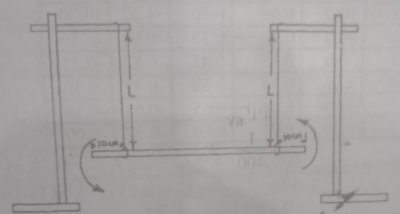
You are provided with two retort stands, two-metre rules, pieces of thread, and other necessary apparatus. ( see illustration above)
i. Set up the apparatus as illustrated above ensuring the strings are permanently 10cm from either end of the rule.
ii. Measure and record the length L = 80 cm of the two strings.
iii. Hold both ends of the rule and displace the rule slightly, then release so that it oscillates about a vertical axis through its centre.
iv. Determine and record the time t for 10 complete oscillations.
v. Determine the period T of oscillations.
vi. Evaluate log T and L.
vii. Repeat the procedure for four other values of L= 70 cm, 60 cm, 50 cm, and 40 cm
viii. Tabulate your readings.
ix. Plot a graph with log T on the vertical axis and log L on the horizontal axis.
x. Determine the slope, s, and the intercept, c on the vertical axis.
xi. State two precautions taken to ensure accurate results.
(b)i. Define simple harmonic motion.
ii. Determine the value of L corresponding to t= 12 s from the graph in 1.

You are provided with a beaker, a thermometer, a stirrer Stopwatch/clock, measuring cylinder, table salt, water, and other necessary materials.
i. You Measure 200cm\(^{3}\) of water into the beaker.
ii. Heat the water until it boils steadily for about 2 minutes.
iii. Read and record the boiling point b\(_{0}\).
iv. Add table salt of mass M = 10.0 g to the boiling water and stir continuously until another boiling point b\(_{1}\) is attained.
v. Read and record b\(_{i}\).
vi. Evaluate \(\theta_{i}\) = (b\(_{i}\) - b\(_{0}\))
vii. Using the same mixture, repeat the procedure four more times by adding 10.0 g of salt each time to give the cumulative mass M\(_{i}\) of salt as 20 g, 30g, 40g, and 50g.
viii. In each case allow the mixture to boil steadily for at least 2 minutes then read and record the boiling point b.
ix. Tabulate your readings.
x. Plot a graph with M\(_{i}\) on the vertical axis and \(\theta_{1}\) on the horizontal axis.
xi. Determine the slope, s, of the graph.
xii. State two precautions taken to ensure accurate results.
(b) i. Define the boiling point of a liquid.
ii. What effects do impurities have on the boiling point of a liquid?

You are provided with cells, a potentiometer, an ammeter, a voltmeter, a bulb, a key, a jockey, and other necessary materials.
i. Measure and record the e.m.f E of the battery.
ii. Set up a circuit as shown in the diagram above.
iii. Close the key K and use the jockey to make a firm.
iii. Contact at J on the potentiometer wire such that PJ = x= 10cm.
iv. Take and record the voltmeter reading V and the () Corresponding ammeter reading.
v. Evalute log V and log I.
vi. Repeat the procedure for five other values of x = 20 cm, 30 cm, 40 cm, 50 cm, and 60 cm.
vii. Tabulate your readings.
viii. Plot a graph with log I on the vertical axis and log V on the horizontal axis.
ix. Determine the slope s, of the graph.
x. Determine the intercept, c, on the vertical axis.
xi. State two precautions taken to ensure accurate results.
(b)i. How is the brightness of the bulb affected as x increases?
ii. List two electrical devices whose actions do not obey Ohm's law.


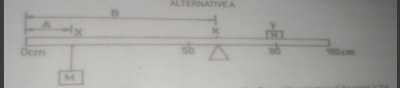
You are provided with a uniform metre rule, a knife-edge, some masses and other necessary materials.
i. Determine and record the centre of gravity of the metre rule.
ii. Fix the 100g mass marked N at a point Y, the 80cm mark of the rule using a sellotape.
iii. Suspend another 50g mass marked M at X, a distance A = 1Ocm from the 0cm mark of the rule.
iv. Balance the arrangement horizontally on the knife edge as illustrated in the diagram above.
v. Measure and record the distance B of a knife-edge from the 0cm mark of the rule.
vi. Repeat the procedure for four other values of A =15cm, 20cm, 25cm and 30cm.
vii. Tabulate your readings.
viii. Plot a graph with B on the vertical axis and A on the horizontal axis.
ix. Determine the slope, s, of the graph.
x. Also determine the intercept, c, on the vertical axis.
xi. Evaluate:
\(\propto\)) = k\(_{1}\) = (\(\frac{1 - 2s}{s}\))100
(\(\beta\)) = k\(_{2}\) = \(\frac{2c}{s}\) = 160
xii. State two precautions taken to obtain accurate results.
(b)i. Define the moment of a force about a point.
ii. State two conditions under which a rigid body at rest remains in equilibrium when acted upon by non-parallel coplanar forces.

You are provided with a beaker, a thermometer, a stirrer, a measuring cylinder, a bunsen burner, a wire gauze, a 50g mass, a pair of tongs, water, tripod stand, and other necessary materials.
i. Using the measuring cylinder, measure 150cm\(^{3}\) of water into the beaker.
ii. Record the volume v of the water in the beaker
iii. Calculate the mass m of the water, given that m = pv and; p = 1gcm\(_{-3}\).
iv. Measure and record the initial temperature \(\theta_{0}\) of the water in the beaker.
v. Hold the 50g mass with the pair of tongs in the flame of the bunsen burner for 2 minutes.
vi. Quickly transfer the 50g mass to water in the beaker.
vii. Stir gently and record the highest temperature \(\theta_{1}\), attained
viii. Evaluate \(\theta\) = (\(\theta_{1}\) - \(\theta_{0}\)).
ix. Empty the content of the beaker and repeat the procedures above for the values of v = 200cm\(^{3}\), 250cm\(^{3}\), 300cm\(^{3}\), and 350 cm\(^{3}\).
x. Tabulate your readings.
xi. Plot a graph with m on the vertical axis and \(\theta\) on the horizontal axis.
xii. Determine the slope, s, of the graph.
xiii. Evaluate k = \(\frac{50}{s}\).
xiv. State two precautions taken to obtain accurate results.
(b)i. Define heat capacity.
ii. An electric kettle rated 1.2kw is used to heat 800g of water initially at a temperature of 20 C. Neglecting heat losses, calculate the time taken for the kettle to heat the water to its boiling point. [Take the boiling point of water= 101 C specific heat capacity of water = 4200 Jkg' K'1 (odv)
