


(a) Explain mutual induction
(b) State four use of electromagnets
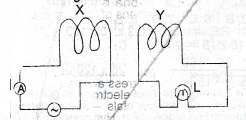
The diagram above illustrates two coils X an arranged so that their axes are collinear. X is connected to an a.c. supply and has an amme in series with it while Y is connected to a lamp Explain the following observations. The (i) lamp is lit when the a.c. supply is switched on;
(ii) brightness of the light from the lamp increases when distance between X. and Y is decreased;
(iii) filament of the lamp glows brighter whet bundle of insulatttriron wires is placed along ccmmon axis of the coils.
(d) Two cells, one have an emf of 2.0 V and an internal resistance of 0.4 and the other having an emf of 2.0 V and an internal resistance of 0.1 \(\Omega\), are connected in parallel. The combination is then connected in series with a resistor.
(i) Draw a circuit diagram of the arrangement.
(ii) Calculate the current through 5\(\Omega\) resistor.
(a) Explain the terms:
(i) transmutation as it relates to radioactivity; (ii) stopping potential.
(b) \(^{23}_{11}A + ^2_1B\) —> \(^p_qC\) + proton
\(^p_qC\) —> \(^r_sE\) + beta
A nucleus C, formed artificially from A and B radioactive and quickly decays to another nucli E as indicated in the nuclear equations abc Datermine the values of p, q, r and s.
(c) A certain metal of work function 1.6 eV is irradiated with ultra-violet light of wavelength 3.6 x 10\(^{-7}\) Calculate the maximum
(i) kinetic energy of ejected electron in joules;
(ii) speed of an emitted electron. (1eV = 1.6 x 10\(^{-18}\) J; C = 3.0 x 10\(^{8}\) ms\(^{-1}\); m, = 9.1 x 10\(^{-31}\) kg; h = 6.6 x 10\(^{-34}\) Js)
(d) If source of the ultra-violet light in (c) above is mo away from the surface of the metal, state the of on the maximum speed of the ejected electron
State three properties of cathode rays which suggest the particle nature of matter

A stone is projected vertically upward with a speed of 30ms\(^{1}\) from the top of a tower of height 50 m. Neglecting air resistance, determine the maximum height it reached from the ground. [g = 10 ms\(^-2\)]
A force of 40 N is applied at the free end of a wire fixed at one end to produce an extension of 0.24 mm. If the original length and diameter of the wire art., 3 m and 2.0 mm respectively, calculate the: (a) stress on the wire; (b) strain in the wire.

