
a. The table shows the scores of 2000 candidates in an entrance examination into a private secondary school.
| % mark | 11 - 20 | 21 - 30 | 31 - 40 | 41 - 50 | 51 - 60 | 61 - 70 | 71 - 80 | 81-90 |
| Number of pupils | 68 | 184 | 294 | 402 | 480 | 310 | 164 | 98 |
Prepare a cumulative frequency table and draw the cumulative frequency curve for the distribution.
bi. Use the curve to estimate the cut-off mark if 300 candidates are to be offered admission.
bii. Use your curve to estimate the probability that a candidate picked at random scored at least 45%
a. A box contains 5 blue balls, 3 black balls, and 2 red balls of the same size. A ball is selected at random from the box and then replaced. A second ball is then selected. Find the probability of obtaining: two red balls
b. A box contains 5 blue balls, 3 black balls, and 2 red balls of the same size. A ball is selected at random from the box and then replaced. A second ball is then selected. Find the probability of obtaining: two blue balls or two black balls
c. A box contains 5 blue balls, 3 black balls, and 2 red balls of the same size. A ball is selected at random from the box and then replaced. A second ball is then selected. Find the probability of obtaining: one black ball and one red ball in any order
If \(\left| \begin{array}{cc} -x & 2 \\ 4x &1 \end{array} \right|\) = \(\left| \begin{array}{cc} 3 & 3x \\ 4 & -5 \end{array} \right|\), find the value of x

A matrix P has an inverse P\(^{-1}\) = \(\begin{pmatrix} 1 & -3 \\ 0 & 1 \end{pmatrix}\). Find P
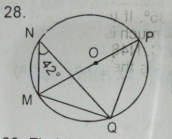
In the diagram above, O is the centre of the circle, POM is a diameter, and \(\angle\) MNQ = 42º. Calculate \(\angle\) QMP.