


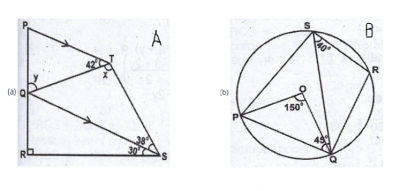
(a) 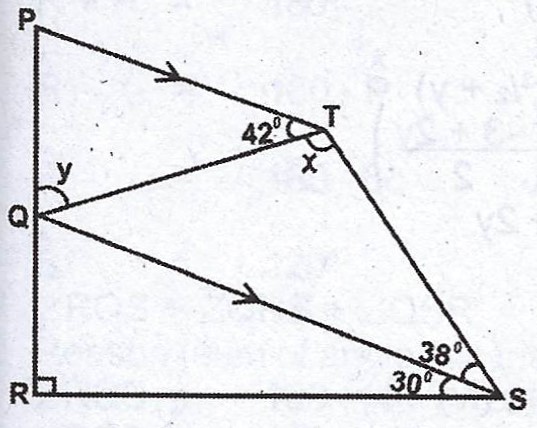
In the diagram, PQRST is a quadrilateral. PT // QS, < PTQ = 42°, < TSQ = 38° and < QSR = 30°. If < QTS = x and < POT = y, find: (i) x ; (ii) y. (SEE THE DIAGRAMS ABOVE)
(b) 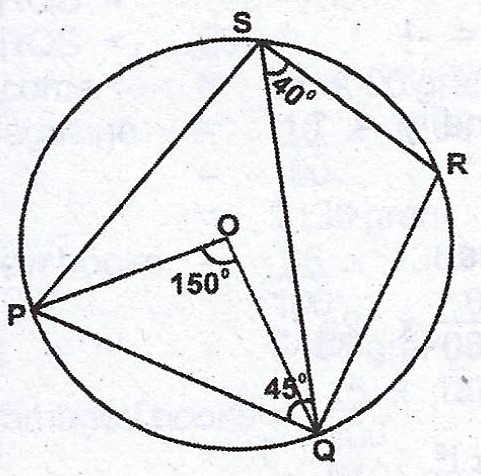
In the diagram, PQRS is a circle centre O. If POQ = 150°, < QSR = 40° and < SQP = 45°, calculate < RQS.
(a) A cylinder with radius 3.5 cm has its two ends closed, if the total surface area is \(209 cm^{2}\), calculate the height of the cylinder. [Take \(\pi = \frac{22}{7}\)].
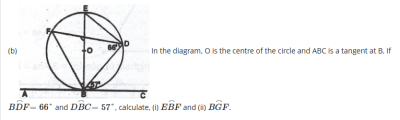
(b) 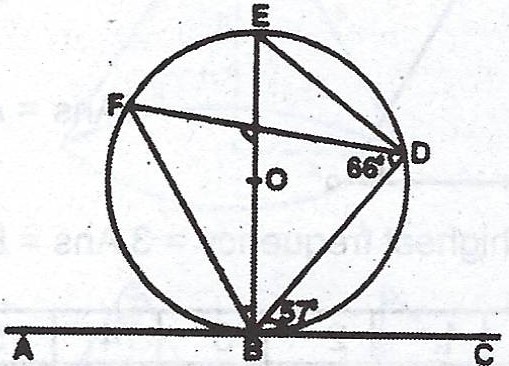 In the diagram, O is the centre of the circle and ABC is a tangent at B. If \(\stackrel\frown{BDF} = 66°\) and \(\stackrel\frown{DBC} = 57°\), calculate, (i) \(\stackrel\frown{EBF}\) and (ii) \(\stackrel\frown{BGF}\).
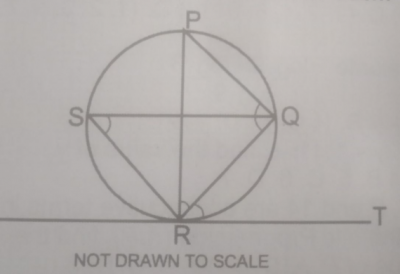
In the diagram, RT is a tangent to the circle at R, < PQR = 70\(^o\), < QRT = 52\(^o\), < QSR and < PRQ = x. Calculate the value of x.

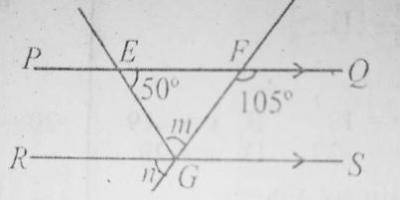
In the diagram, PQ is parallel to RS, < QFG = 105\(^o\) and < FEG = 50\(^o\). Find the value of n
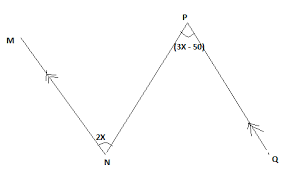
In the diagram, \(\overline{MN}\)//\(\overline{PQ}\), < MNP = 2x, and < NPQ = (3x - 50)°. Find the value of < NPQ

