


(a) Two cyclists X and Y leave town Q at the same time. Cyclist X travels at the rate of 5 km/h on a bearing of 049° and cyclist Y travels at the rate of 9 km/h on a bearing of 319°.
(a) Illustrate the information on a diagram.
(b) After travelling for two hours, calculate. correct to the nearest whole number, the:
(i) distance between cyclist X and Y;
(ii) bearing of cyclist X from Y.
(c) Find the average speed at which cyclist X will get to Y in 4 hours.
The table shows the distribution of marks obtained by students in an examination.
| Marks (%) | 0 - 9 | 10 - 19 | 20 - 29 | 30 - 39 | 40 - 49 | 50 - 59 | 60 - 69 | 70 - 79 | 80 - 89 | 90 - 99 |
| Frequency | 7 | 11 | 17 | 20 | 29 | 34 | 30 | 25 | 21 | 6 |
(a) Construct a cumulative frequency table for the distribution.
(b) Draw the cumulative frequency curve for the distribution.
(c) Using the curve, find correct to one decimal place, the:
(i) median mark;
(ii) lowest mark for the distinction if 5% of the students passed with distinction
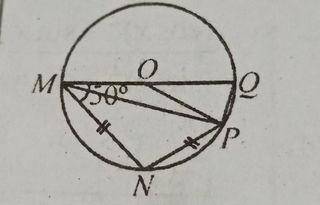
(a) In the diagram, MNPQ is a circle with centre O, |MN| = |NP| and < OMN = 50°. Find:
(I) < MNP
(ii) < POQ
(b) Find the equation of the line which has the same gradient as 8y + 4xy = 24 and passes through the point (-8, 12)

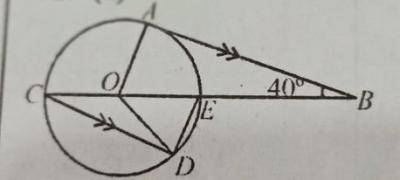
(a) In the diagram, AB is a tangent to the circle with centre O, and COB is a straight line. If CD//AB and < ABE = 40°, find: < ODE.
(b) ABCD is a parallelogram in which |\(\overline{CD}\)| = 7 cm, I\(\overline{AD}\)I = 5 cm and < ADC= 125°.
(i) Illustrate the information in a diagram.
(ii) Find, correct to one decimal place, the area of the parallelogram.
(c) If x = \(\frac{1}{2}\)(1 - \(\sqrt{2}\)). Evaluate (2x\(^2\) - 2x).
correct 0.007985 to three significant figures.

