


(a) Find the number N such that when \(\frac{1}{3}\) of it is added to 8, the result is the same as when \(\frac{1}{2}\) of it is subtracted from 18.
(b) Using a ruler and a pair of compasses only, construct a trapezium ABCD, in which the parallel sides AB and DC are 4 cm apart. < DAB = 60°, /AB/ = 8 cm and /BC/ = 5 cm. Measure /DC/.
(a) Copy and complete the table for \(y = 3x^{2} - 5x - 7\)
| x | -3 | -2 | -1 | 0 | 1 | 2 | 3 | 4 |
| \(y = 3x^{2} - 5x - 7\) | 35 | -7 | -9 | 5 |
(b) Using a scale of 2cm = 1 unit along the x- axis and 2cm = 5 units along the y- axis, draw the graph of \(y = 3x^{2} - 5x - 7\).
(c) On the same axis, draw the graph of \(y + 3x + 2 = 0\).
(d) From your graph, find the : (i) range of values of x for which \(3x^{2} - 5x - 7 < 0\) ; (ii) roots of the equation \(3x^{2} - 2x - 5 = 0\).
(a) Make d the subject of the formula \(S = \frac{n}{2}[2a + (n - 1) d]\).
(b) (i) 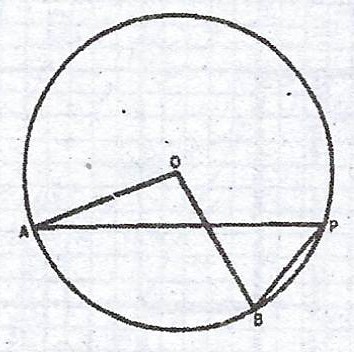
In the diagram, O is the centre of the circle, A, B and P are points on the circumference. Prove that < AOB = 2 < APB.
(ii) 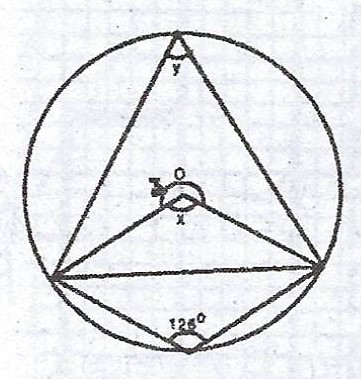
Find the angles x, v and z in the diagram.


(a) P and Q are points on the parallel of latitude 68.7°S, their longitudes being 124°W and 56°E respectively. What is their distance apart measured along the parallel of latitude? [Take R = 6400km, \(\pi = 3.142\)]. (Give your answers to 3 significant figures).
(b) A bag contains four red, three white and five green balls. (i) If one ball is picked at random, what is the probability that it is not green? (ii) if two balls are picked at random without replacement, what is the probability that one is red and the other white?
Two men P and Q set off from a base camp R, prospecting for oil. P moves 20km on a bearing of 205° and Q moves 15km on a bearing of 060°. Calculate the:
(a) distance of Q from P ;
(b) bearing of Q from P.
(Give your answer in each case to the nearest whole number)
