


(a) Two places X and Y on the equator are on longitudes 67°E and 123°E respectively. (i) What is the distance between them along the equator? (ii) How far from the North pole is X? [Take \(\pi = \frac{22}{7}\) and radius of earth = 6400km].
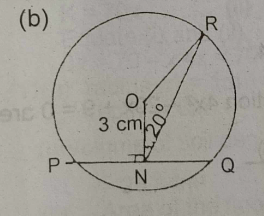
(b) SEE FIGURE B above, In the diagram, PQR is a circle centre O. N is the mid-point of chord PQ. |PQ| = 8cm, |ON| = 3cm and < ONR = 20°. Calculate the size of < ORN to the nearest degree.
(a) Simplify \((\frac{4}{25})^{-\frac{1}{2}} \times 2^{4} \div (\frac{15}{2})^{-2}\)
(b) Evaluate \(\log_{5} (\frac{3}{5}) + 3 \log_{5} (\frac{5}{2}) - \log_{5} (\frac{81}{8})\).
(a) If \(\varepsilon\) is the set \({1, 2, 3,..., 19, 20}\) and A, B and C are subsets of \(\varepsilon\) such that A = { multiples of five}, B = {multiples of four} and C = {multiples of three}, list the elements of (i) A ; (ii) B ; (iii) C ;
(b) Find : (i) \(A \cap B\) ; (ii) \(A \cap C\) ; (iii) \(B \cup C\).
(c) Using your results in (b), show that \((A \cap B) \cup (A \cap C) = A \cap (B \cup C)\).


ABC is a triangle, right-angled at C. P is the mid-point of AC, < PBC = 37° and |BC| = 5 cm. Calculate :
(a) |AC|, correct to 3 significant figures ;
(b) < PBA.
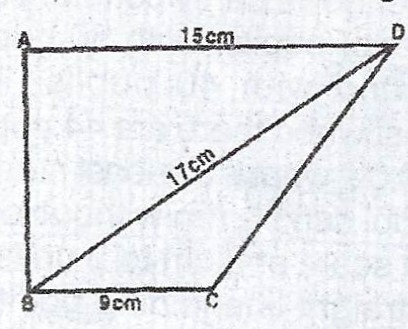
In the diagram, ABCD is a trapezium in which \(AD \parallel BC\) and \(< ABC\) is a right angle. If |AD| = 15 cm, |BD| = 17 cm and |BC| = 9 cm, calculate :
(a) |AB| ;
(b) the area of the triangle BCD ;
(c) |CD| ;
(d) perimeter of the trapezium.
