


(a) The roots of the equation \(2x^{2} + (p + 1)x + 9 = 0\), are 1 and 3, where p and q are constants. Find the values of p and q.
(b) The weight of an object varies inversely as the square of its distance from the centre of the earth. A small satellite weighs 80kg on the earth's surface. Calculate, correct to the nearest whole number, the weight of the satellite when it is 800km above the surface of the earth. [Take the radius of the earth as 6,400km].
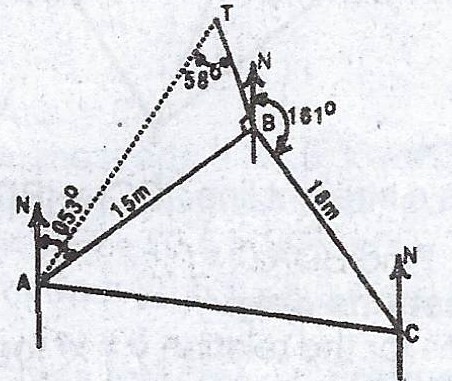 In the diagram, three points A, B and C are on the same horizontal ground. B is 15m from A, on a bearing of 053°, C is 18m from B on a bearing of 161°. A vertical pole with top T is erected at B such that < ATB = 58°. Calculate, correct to three significant figures,
(a) the length of AC.
(b) the bearing of C from A ;
(c) the height of the pole BT.
(a) A boy blew his rubber balloon to a spherical shape. The balloon burst when its diameter was 15 cm. Calculate, correct to the nearest whole number, the volume of air in the balloon at the point of bursting. [Take \(\pi = \frac{22}{7}\)]
(b) A point X is on latitude 28°N and longitude 105°W. Y is another point on the same latitude as X but on longitude 35°E. (i) Calculate, correct to three significant figures, the distance between X and Y along latitude 28°N ; (ii) How far is X from the equator? [Take \(\pi = \frac{22}{7}\) and radius of the earth = 6,400km].

(a) Evaluate and express your answer in standard form : \(\frac{4.56 \times 3.6}{0.12}\)
(b) Without using mathematical tables or calculator, evaluate \((73.8)^{2} - (26.2)^{2}\).
(c) Simplify \(\sqrt{1\frac{19}{81}}\), expressing your answer in the form \(\frac{a}{b}\) where a and b are positive integers.
(a) Given that cos x = 0.7431, 0° < x < 90°, use tables to find the values of : (i) 2sin x ; (ii) tan\(\frac{x}{2}\).
(b) The interior angles of a pentagon are in ratio 2 : 3: 4: 4: 5. Find the value of the largest angle.

