


(a) Using a ruler and a pair of compasses only, construc :
(i) a triangle PQR such that /PQ/ = 10 cm, /QR/ = 7 cm and < PQR = 90° ; (ii) the locus \(l_{1}\) of points equidistant from Q and R ; (iii) the locus \(l_{2}\) of points equidistant from P and Q.
(b) Locate the point O equidistant from P, Q and R.
(c) With O as centre, draw the circumcircle of the triangle PQR.
(d) Measure the radius of the circumcircle.
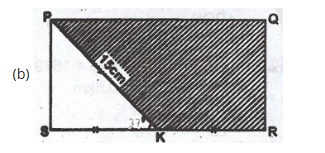
(a) Simplify : \(\frac{x^{2} - y^{2}}{3x + 3y}\)
(b) 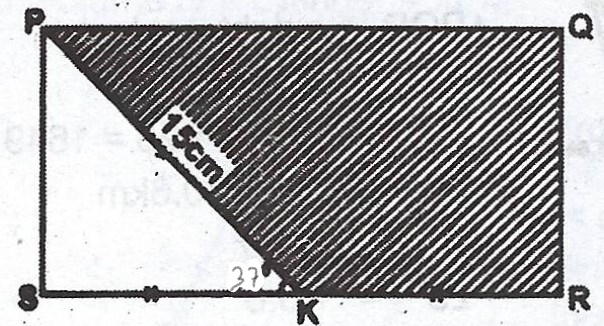
In the diagram, PQRS is a rectangle. /PK/ = 15 cm, /SK/ = /KR/ and
(a) 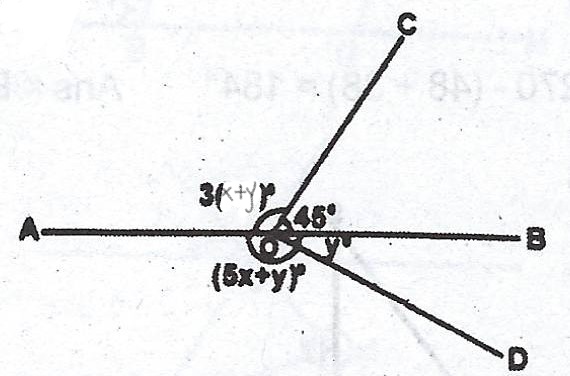
In the diagram, AOB is a straight line. < AOC = 3(x + y)°, < COB = 45°, < AOD = (5x + y)° and < DOB = y°. Find the values of x and y.
(b) From two points on opposite sides of a pole 33m high, the angles of elevation of the top of the pole are 53° and 67°. If the two points and the base are on te same horizontal level, calculate, correct to three significant figures, the distance between the two points.

(a) The 3rd and 8th terms of an arithmetic progression (A.P) are -9 and 26 respectively. Find the : (i) common difference ; (ii) first term.
(b) 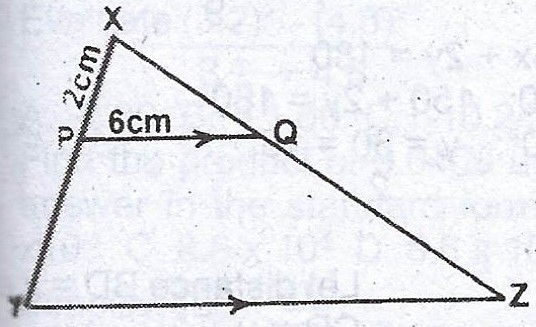
In the diagram \(\overline{PQ} || \overline{YZ}\), |XP| = 2cm, |PY| = 3 cm, |PQ| = 6 cm and the area of \(\Delta\) XPQ = 24\(cm^{2}\).Calculate the area of the trapezium PQZY.
In a college, the number of absentees recorded over a period of 30 days was as shown in the frequency distribution table
| Number of absentees | 0-4 | 5-9 | 10-14 | 15-19 | 20-24 |
| Number of Days | 1 | 5 | 10 | 9 | 5 |
Calculate the : (a) Mean
(b) Standard deviation , correct to two decimal places.

