


(a) Use logarithm tables to evaluate \(\frac{15.05 \times \sqrt{0.00695}}{6.95 \times 10^{2}}\).
(b) The first 5 students to arrive in a school on a Monday morning were 2 boys and 3 girls. Of these, two were chosen at random for an assignment. Find the probability that :
(i) both were boys ; (ii) the two were of different sexes.
(a) Using a ruler and a pair of compasses only, construst \(\Delta\) ABC in which |AB| = 7cm, |BC| = 5cm and < ABC = 75°. Measure |AC|.
(b) In (a) above, locate by construction, a point D such that CD is parallel to AB and D is equidistant from points A and C. Measure < BAD.
(a) Solve the simultaneous equation : \(\log_{10} x + \log_{10} y = 4\)
\(\log_{10} x + 2\log_{10} y = 3\)
(b) The time, t, taken to buy fuel at a petrol station varies directly as the number of vehicles V on queue and jointly varies inversely as the number of pumps P available in the station. In a station with 5 pumps, it took 10 minutes to fuel 20 vehicles. Find :
(i) the relationship between t, P and V ; (ii) the time it will take to fuel 50 vehicles in the station with 2 pumps ; (iii) the number of pumps required to fuel 40 vehicles in 20 minutes.


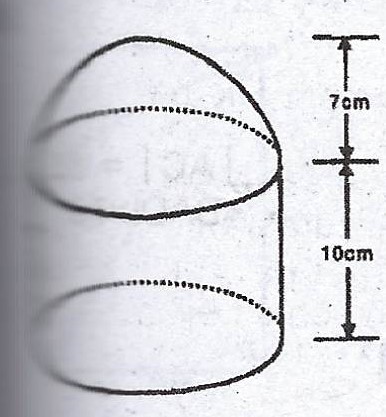 The solid is a cylinder surmounted by a hemispherical bowl. Calculate its
(a) total surface area ;
(b) volume (Take \(\pi = \frac{22}{7}\))

Above is the graph of the quadratic function \(y = ax^{2} + bx + c\) where a, b and c are constants. Using the graph, find :
(a)(i) the scales on both axes ; (ii) the equation of the line of symmetry of the curve ; (iii) the roots of the quadratic equation \(ax^{2} + bx + c = 0\)
(b) Use the coordinates of D, E and G to find the values of the constants a, b and c hence write down the quadratic function illustrated in the graph.
(c) Find the greatest value of y within the range \(-3 \leq x \leq 5\).
