


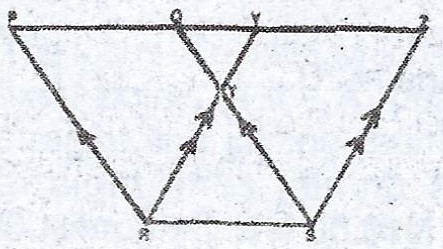
(a) In the diagram, PQSR and SRYZ are parallelograms and PQYZ is a straight line. If /QY/ = 2cm and /RS/ = 3cm, find /PZ/.
(b) P and Q are two towns on the earth's surface on latitude 56°N. Thei longitudes are 25°E and 95°E respectively. Find the distance PQ along their parallel of latitude, correct to the nearest km. [Take radius of the earth as 6400km and \(\pi = \frac{22}{7}\)]
(a) A pack of 52 playing cards is shuffled and a card is drawn at random. Calculate the probability that it is either a five or a red nine.
[Hint : There are 4 fives and 2 red nines in a pack of 52 cards]
(b) P, Q and R are points in the same horizontal plane. The bearing of Q from P is 150° and the bearing of R from Q is 060°. If /PQ/ = 5m and /QR/ = 3m, find the bearing of R from P, correct to the nearest degree.
The frequency table shows the marks scored by 32 students in a test.
| Marks scored | 1 | 2 | 3 | 4 | 5 | 6 | 7 | 8 | 9 | 10 |
| No of students | 2 | 3 | 4 | 4 | 4 | 4 | 5 | 3 | 2 | 1 |
Find the :
(a)(i) mean ; (ii) median ; (iii) mode of the marks;
(b) percentage of the students who scored at least 8 marks.


(a) Using mathematical tables, find ; (i) \(2 \sin 63.35°\) ; (ii) \(\log \cos 44.74°\);
(b) Find the value of K given that \(\log K - \log (K - 2) = \log 5\);
(c) Use logarithm tables to evaluate \(\frac{(3.68)^{2} \times 6.705}{\sqrt{0.3581}}\)
(a) Given that \(p = x + ym^{3}\), find m in terms of p, x and y.
(b) Using the method of completing the square, find the roots of the equation \(x^{2} - 6x + 7 = 0\), correct to 1 decimal place.
(c) The product of two consecutive positive odd numbers is 195. By constructing a quadratic equation and solving it, find the two numbers.
