


(a) If \(\log_{10} (3x - 1) - \log_{10} 2 = 3\), find the value of x.
(b) Use logarithm tables to evaluate \(\sqrt{\frac{0.897 \times 3.536}{0.00249}}\), correct to 3 significant figures.
A bag contains 12 white balls and 8 black balls, another contains 10 white balls and 15 black balls. If two balls are drawn, without replacement from each bag, find the probability that :
(a) all four balls are black ;
(b) exactly one of the four balls is white.
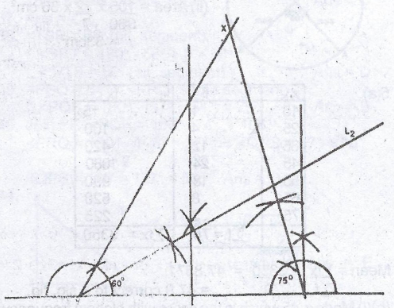
(a) Using a ruler and a pair of compasses only, construct (i) a triangle XYZ in which /YZ/ = 8cm, < XYZ = 60° and < XZY = 75°. Measure /XY/; (ii) the locus \(l_{1}\) of points equidistant from Y and Z ; (iii) the locus \(l_{2}\) of points equidistant from XY and YZ.
(b) Measure QY where Q is the point of intersection of \(l_{1}\) and \(l_{2}\).

The table below gives the ages, to the nearest 5 years of 50 people.
| Age in years | 10 | 15 | 20 | 25 | 30 |
| No of people | 8 | 19 | 10 | 7 | 6 |
(a) Construct a cumulative frequency table for the distribution.
(b) Draw a cumulative frequency curve (Ogive)
(c) From your Ogive, find the : (i) median age ; (ii) number of people who are at most 15 years of age ; (iii) number of people who are between 20 and 25 years of age.
(a) Copy and complete the following table of values for \(y = 2x^{2} - 9x - 1\).
| x | -1 | 0 | 1 | 2 | 3 | 4 | 5 | 6 |
| y | -1 | -8 | -11 | 17 |
(b) Using a scale of 2cm to represent 1 unit on the x- axis and 2cm to represent 5 units on the y- axis, draw the graph of \(y = 2x^{2} - 9x - 1\).
(c) Use your graph to find the : (i) roots of the equation \(2x^{2} - 9x = 4\), correct to one decimal place ; (ii) gradient of the curve \(y = 2x^{2} - 9x - 1\) at x = 3.

