


(a) Prove that the angle which an arc of a circle subtends at the centre is twice that which it subtends at any point on the remaining part of the circumference.
(b) 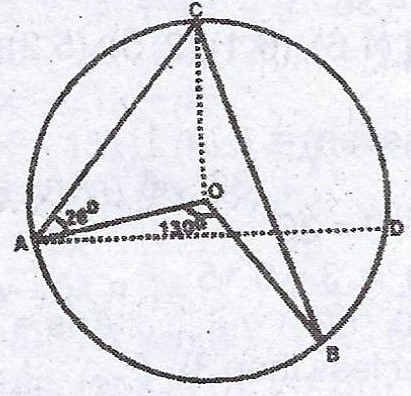
In the diagram, O is the centre of the circle ACDB. If < CAO = 26° and < AOB = 130°. Calculate : (i) < OBC ; (ii) < COB.
(a) What is the 25th term of 5, 9, 13,... ?
(b) Find the 5th term of \(\frac{8}{9}, \frac{-4}{3}, 2, ...\).
(c) The 3rd and 6th terms of a G.P are \(48\) and \(14\frac{2}{9}\) respectively. Write down the first four terms of the G.P.
(a) Copy and complete the following table of values for \(y = 3\sin 2\theta - \cos \theta\).
| \(\theta\) | 0° | 30° | 60° | 90° | 120° | 150° | 180° |
| y | -1.0 | 0 | 1.0 |
(b) Using a scale of 2cm to 30° on the \(\theta\) axis and 2cm to 1 unit on the y- axis, draw the graph of \(y = 3 \sin 2\theta - \cos \theta\) for \(0° \leq \theta \leq 180°\).
(c) Use your graph to find the : (i) solution of the equation \(3 \sin 2\theta - \cos \theta = 0\), correct to the nearest degree; (ii) maximum value of y, correct to one decimal place.

The table below shows the frequency distribution of the marks scored by fifty students in an examination.
| Marks (%) | 0-9 | 10-19 | 20-29 | 30-39 | 40-49 | 50-59 | 60-69 | 70-79 | 80-89 | 90-99 |
| Freq | 2 | 3 | 4 | 6 | 13 | 10 | 5 | 3 | 2 | 2 |
(a) Draw the cumulative frequency curve for the distribution.
(b) Use your curve to estimate the : (i) upper quartile; (ii) pass mark if 60% of the students passed.
P and Q are two points on latitude 55°N and their longitudes are 33°W and 23°E respectively. Calculate the distance between P and Q measured along
(a) the parallel of latitude ;
(b) a great circle.
[Take \(\pi = \frac{22}{7}\) and radius of the earth = 6400km].

