


What is the probability that a total sum of seven would appear in two tosses of a fair die?
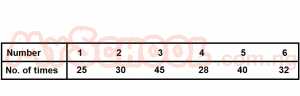
A die is rolled 200 times the outcomes obtained are shown in the table below.
Find the probability of obtaining 2.
| Number | 1 | 2 | 3 | 4 | 5 | 6 |
| No of times | 25 | 30 | 45 | 28 | 40 | 32 |
A die rolled 200 times. The outcome obtained are shown in the table above.
What is the probability of obtaining a number less than 3 ?

(a) Simplify, without using Mathematical tables: \(\log_{10} (\frac{30}{16}) - 2 \log_{10} (\frac{5}{9}) + \log_{10} (\frac{400}{243})\)
(b) Without using Mathematical tables, calculate \(\sqrt{\frac{P}{Q}}\) where \(P = 3.6 \times 10^{-3}\) and \(Q = 2.25 \times 10^{6}\), leaving your answer in standard form.
The universal set \(\varepsilon\) is the set of all integers and the subset P, Q, R of \(\varepsilon\) are given by:
\(P = {x : x < 0} ; Q = {... , -5, -3, -1, 1, 3, 5} ; R = {x : -2 \leq x < 7}\)
(a) Find \(Q \cap R\).
(b) Find \(R'\) where R' is the complement of R with respect to \(\varepsilon\).
(c) Find \(P' \cup R'\)
(d) List the members of \((P \cap Q)'\).

