


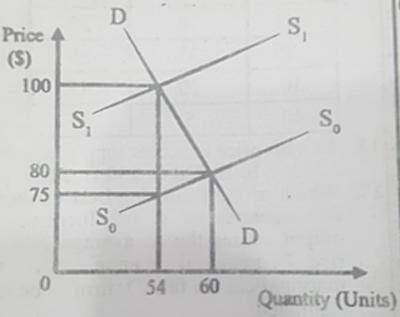
The graph shows the imposition of tax on the sellers of a product. Study the graph and answer the questions that follows
(a) Identify the;
(i) price per unit of the product before
(ii) quantity demanded and supplied before tax;
(iii)price per unit of the product after tax;
(iv) quantity demanded and supplied after tax.
(b) Determine the:
(i) amount of tax imposed per unit of the product
(ii) amount retained per unit by the sellers after tax.
(c) Calculate the percentage of the total tax imposed that is paid by;
(i) buyers per unit, (ii) sellers per unit
The management of a fruit juice pro- duction company was directed by the shareholders to increase the revenue from the sale of its product. The management decided to increase the price of the fruit juice from $7 to $$ 10 per unit and this led to a fall in quantity demanded from 150 units to 30 units.
Use the information above to answer the questions that follow.
(a) Calculate the;
(i) Percentage increase in the price; (ii) percentage decrease in the quantity demanded
(iii)coefficient of price elasticity of demand for the fruit juice.
(b) Is the demand for the fruit, price elastic or inelastic? Give a reason for your
answer.
(c) Did the management of the company achieve its objective of increasing revenue? Explain your answer.
(d) From your answers in 2a(iii), was the increase in the price of the fruit juice a rational strategy to employ in order to increase revenue? Explain your answer.
(a) With the aid of relevant diagrams, distinguish between an increase in supply and an increase in quantity supplied.
(b) Explain how a decrease in income tax will affect the demand for a normal good and an inferior good.
(c) Explain how an increase in the supply of a substitute will affect the demand for a commodity.
(a)Define the term distribution.
(b) Outline three ways in which the retail- er is important to the consumer.
(c) Explain three disadvantages of the operation of middlemen in the distribution process
(a) Explain the following concepts (i) labour force; (ii) over-population; (iii) Mobility of labour (iv) optimum population
(b) Outline four factors responsible for the rapid growth in the population of a country.


