


(a) What is meant by each of the following terms?:
(i) Esterification
(ii) Saponification
(b)(i) Give the general molecular formula of alkynes
(ii) Write the molecular formula and empirical formula of ethylethanoate.
(iii) Draw the structure of 1, 1, 2, 2-tetrabromoethane
(iv) Write an equation for the reaction of ethanol with sodium
(c) Consider the following reaction schemes:
I II
Petroleum ---> Petroleum Fractions. Higher Petroleum Fractions ---> Petrol + X
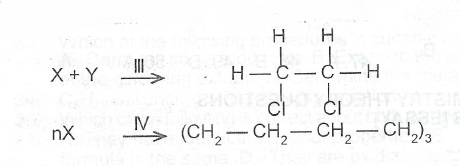
(i) State type of process/reaction involved in each of the stages labelled I to IV.
(ii) Identify X and Y
(iii) Give the IUPAC name of the product obtained in stage III.
(iv) What are the reaction conditions for stage IV?
(d) Explain why palm wine: (i) froths or foams (ii) tastes sour after some days.
(a)(i) Give the names of two allotropes of sulphur.
(ii) State and explain what is observed when hydrogen sulphide is bubbled through acidified potassium tetraoxomanganate (VII) solution
(iii) List one product of the reaction of sulphur (IV) oxide with hydrogen sulphide
(b)(i) What are the raw materials for the manufacture of tetraoxosulphate (VI) acid by the contact process?
(ii) Write an equation for the reaction that requires a catalyst in the contact process and state the catalyst used.
(iii) State the observation and the product formed when concentrated H\(_2\)SO\(_4\) reacts with each of the following:
I. Copper turnings Ii. A cube of sugar
(c)(i) Give three uses of sodium trioxocarbonate (IV).
(ii) What name is given to reactions of the following type?:
exposure to air
Na\(_2\)CO\(_3\) + 10H\(_2\)O\(_{(s)}\) \(\to\) Na\(_2\)CO\(_3\); H\(_2\)O\(_{(S)}\) + 9H\(_2\)O
(iii) Calculate the solubility of Na\(_2\)CO\(_3\) at 25°C, if 20 cm\(^3\) of its saturated solution at that temperature gave 1.75g of the anhydrous salt. [C = 12, O = 16, Na = 23].
(a) State how you would carry out the following procedures in the laboratory:
(i) Remove the sediment in sample of water;
(ii) Soften temporarily hard water without heating it,
(iii) Obtain pure water from muddy water;
(iv) Remove oxygen and moisture from a sample of air
(b)(i) What type of salts are alums?
(ii) State the function of alum in water treatment plants.
(iii) State and explain how rain water that hac passed through limestone deposits will react with soap solution.
(c)(i) Write an equation for the laboratory preparation of chlorine
(ii) List the products of the reaction of chlorine with hot concentrated sodium hydroxide solution
(iii) What is observed when moist blue litmus paper comes in contact with chlorine?
(iv) Calculate the volume of chlorine at s.t.p. that would be required to react completely with 3.70g of dry slaked lime according to the following equation:
Ca(OH)\(_{2(s)}\) + Cl\(_{2(g)}\) --> CaOCl\(_{2}\). H\(_2\)O\(_{(s)}\) [H = 1, O = 16, Ca = 40, 1 mole of gas occupies 22.4 dm\(^3\) at s.t.p.]
(d)(i) State what is observed on warming ammonium trioxonitrate (V) with sodium hydroxide solution
(ii) Explain why ammonium trioxocarbonate (IV) leaves no residue on being heated.


(a)(i) State three postulates of the kinetic theory of gases.
(ii) Draw a sketch to illustrate Boyle's law.
(iii) Explain what is meant by "absolute zero of temperature".
(b) Equal volumes of a gas X and oxygen are at the same pressure but temperature of 200 K and 800K respectively.
(i) Giving reason for your answer, state which of the gas samples contains the greater number of molecules.
(ii) If the mass of one molecule of the gas X is 2.19 x 10\(^{-22}\) g, determine the molar mass of X. [Avogadro constant = 6.02 x 10\(^{-23}\)]
(iii) Hence, state with reason which of X and oxygen will diffuse faster under the same conditions. [O= 16].
(c)(i) Mention two reaction conditions that can increase the yield of ammonia in the reaction represented by the following equation: N\(_{2(g)}\) + 3H\(_{2(9)}\) \(\rightleftharpoons\) 2NH\(_{3(g)}\) \(\Dellta\)H = -46kJmol\(^{-1}\). Draw a labelled energy profile diagram for an endothermic reaction.
(iii) A solid W decomposes on heating according to the following equation: W\(_{(s)} \to Y_{(s}) + Z_{(g)}\) List two factors apart from temperature, which can affect the rate of the reaction.
a)(i) State three differences between covalent compounds and electrovalent compounds.
(ii) Two elements represented as K and L have atomic numbers of 12 and 8 respectively. Write their electronic structures and state the group to which each belongs in the Periodic Table.
(iii) If an alkali metal M exists naturally as the oxide, state with reason whether or not M can be extracted by reduction of the oxide with coke.
(b)(i) What is meant by the half-life of a radioactive element?
(ii) Mention the radioactive isotope used in dating archaeological specimens.
(iii) Balance the following equation and identify Q,
\(^{28}_{13}Al\) —> \(^{24}_{13}Si + \(^{0_1Q\)
(c)(i). Give three chemical properties of metals.
(ii) State two reasons why duralumin preferred to steel in aircraft manufacture.
(iii) What term is used to describe the ability of metals to be hammered into thin sheets?
(iv) Calculate the number of mole of electrons involved in the oxidation of 2.8g of iron filings to iron (II) ions. [Fe = 56].
